Operations research

What’s new?

In the 12 June issue of Defence Connect reports the former chief of the Royal Australian Navy, Tim Barrett, is quoted as saying that the regeneration of the Australian fleet over the next decade “is an ideal opportunity for Australia to make significant changes to structure and strategy – not just in terms of the fleet itself, that is, but how deployments are analysed. To that end, he calls for a `thinking navy’, arguing the OR [Operations Research] is a crucial piece of this puzzle.”

What does it mean?

Operations research is, of course, research on operations. INFORMS (the Institute for Operations Research and the Management Sciences) states “Operations research (O.R.) is defined as the scientific process of transforming data into insights to making better decisions.” INFORMS pairs OR with Analytics, adding, “Analytics is the application of scientific & mathematical methods to the study & analysis of problems involving complex systems.”

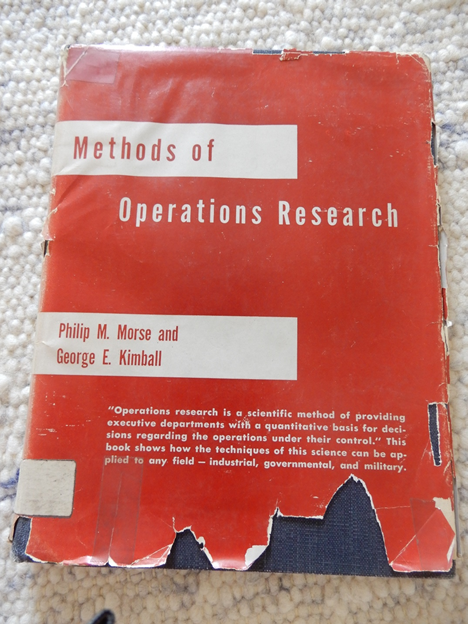
Operations research began with military applications.  The above picture shows my copy of the first textbook on OR, Methods of Operations Research, by Philip M. Morse (my academic grandfather, that is, he was the PhD advisor of my PhD advisor) and George E. Kimball (1950, MIT Press and John Wiley & Sons). The two authors were members of the Operations Research Group of the U.S. Navy and the first version of the book was published as a classified document just after World War II.

The first sentence of the book defines OR: “Operations research is a scientific method of providing executive departments with a quantitative basis for decisions regarding the operations under their control.” Morse was a professor of physics and Kimball of chemistry, so they were familiar with the scientific method; they and others contributed to the war effort by applying the scientific method to improve operations. Presciently, they remarked “experience since the war has shown [that] the techniques and approach of operations research can be of help in arriving at executive decisions concerning operations in any field, industrial and governmental as well as military.” Indeed, many parts of engineering started with military engineering and only later became civil engineering, as seen in the legacy of that term.

This book is a nice introduction to OR. On page 3, the authors give their first simple example still often cited by OR researchers and practitioners:

The first example, simple to the point of triviality, involves the line-up of soldiers washing their mess kits after eating at a field mess station. An operations research worker during his first day of assignment to a new field command noticed that there was considerable delay caused by the soldiers having to wait in line to wash and rinse their mess kits after eating. There were four tubs, two for washing and two for rinsing. The operations research worker noticed that on the average it took three times as long for the soldier to wash his kit as it did for him to rinse it. He suggested that, instead of there being two tubs for washing and two for rinsing, there should be three tubs for washing and one for rinsing. This change was made, and the line of waiting soldiers did not merely diminish in size; on most days no waiting line every formed.

They point out several features of this story. “[T]he solution, when seen, was absurdly simple …” The improvement required no additional equipment. The solution was conveyed to someone who could make the needed change – and did. Finally, the waiting was reduce to almost zero when the flow should have increased by 50 percent; waiting lines have the property that “the longer they get, the longer they tend to get,” a “self-aggravating property” present in many system. This story and the analysis still make me smile, almost 50 years after I first read them.

They describe other examples of OR that require more analysis and more technical background, including optimizing the depth setting of antisubmarine depth charges to improve the sinking of U-boats and setting the size of convoys to reduce average ship losses. They discuss the problem of finding the problem, sensitivity analysis, and more.

Since that book, OR has expanded greatly. INFORMS lists, among others, the following techniques and subfields: algorithms, databases, decision analysis, dynamic program/optimal control, facilities planning, forecasting, game theory, inventory management / production planning, optimization / mathematical programming, probability and stochastic models, quality and reliability, queueing models, scheduling, search and surveillance, simulation, systems thinking, time series methods, and utility and value theory. These techniques of OR have wide application.

Linear programming, a technique for optimization, involves choosing values for specified decision quantities to maximize or minimize a function of those quantities; the chosen values must also satisfy certain constraints (equations or inequalities).  All functions in the mathematical formulation are linear in form concerning the decision variables.

For example, in 1945 George Stigler described the diet problem in which the amounts of foods in a diet are chosen to minimize the cost of the diet while meeting the minimum daily requirements of different nutrients. When I was a faculty member at Ohio State in the 1980s I worked with some agricultural engineering faculty; Ohio State produced a program to help dairy farmers optimize the feed for cattle using the linear programming formulation of the diet problem. In 2012, Ohio State professor Dr Luis Morales published a paper updating the diet problem for cattle to include consideration of methane emissions from cattle.

OR problems are often formulated in mathematics and the solution methods are often sophisticated. George Dantzig, later a professor of operations research at Stanford, formulated the military planning problems he worked on during the war as a linear programming model. He eventually developed a method for the solution of such problems, called the simplex method.

The linear programming model and the simplex method are just one example of an OR problem and associated solution method with wide applicability. Successful application of linear programming models (and generalizations) include assigning jobs to machines, scheduling of crews for airlines, routing products from production facilities to warehouses to retail locations, selecting the highest value way to cut a log into lumber, scheduling jobs through a production process, minimizing the distance travelled to deliver meals in a Meals-on-Wheels program, and so forth. The use of linear programming is often taught in business programs, especially MBA programs.

Other methods of OR incorporate uncertainty by modeling using the mathematics of probability. All OR methods require data about the real world system. The Defence Connect article I started this article with quotes the Head of US Naval Air Forces Vice Admiral DeWolfe Miller as saying “I love data,” one of my favorite sayings.

What does it mean for you?

This week I attended the online national conference of the American Society for Engineering Education (ASEE), the international organization where engineering faculty present research, discuss, and learn how to improve engineering education. A nice paper presented there (“Creating a Community of Practice for Operations Research by Co-creating a High Impact Executive Education Program in India,” by Venugopalan Kovaichelvan and Patrick A Brunese,) described a program at a company in India, in which senior managers from the Indian company worked with faculty from a US university to create three modules delivered to students over a 10 month period using online, on site, synchronous and asynchronous modes of delivery, combining learning with immediate application to supply chain problems. The topics focused on sensing and framing problems, developing a model for study, selecting appropriate modeling methods and data, applying the methods, interpreting results, implementing and validating the solution, and developing a comprehensive framework for decision support. Students worked on projects they identified (for example, reorganizing a distribution network for a particular product) and their work was rigorously assessed. Graduates are supported in a community of practice and 32 senior managers are now qualified as advanced OR practitioners. Savings from the 14 initial projects provided “one-time monetary benefits equivalent to the investment for the entire development and delivery of the advanced OR program.”

The first delivery of the program was done by US faculty and the second iteration is being delivered by participants from the first program. A social learning program is supporting the 60 members of the community of practice.

I started this article with a quote from Tim Barrett former chief of the Royal Australian Navy, including his call for a “thinking navy.” Seventy years ago, in the final chapter of Methods of Operations Research, Morse and Kimball wrote:

“Referring again to the first sentence of Chapter 1 [the definition of operations research], we may emphasize at this point that operations research is not a pure research activity separated from all else; it is an integral part of an operating organization. It is a part of the thinking process of the operating organization, so to speak, the summing up of the facts bearing on the problem before a decision is made. Separate existence, by itself, would be as anomalous as the separate existence of the front lobe of a brain without the rest of the brain and body.” [emphasis added]

Thinking doesn’t just occur with OR methods, but the habits of OR certainly do promote thinking – logical thinking based on data. Is your organization a thinking organization? How do you promote the rigorous identification and solution of problems? OR may be a part of the strategy you use to answer those questions.

Where can you learn more?

The papers from the 2020 conference of the American Society for Engineering Education will soon be available here.

INFORMS has excellent information about Operations Research.

The Library of Congress listing for Methods of Operations Research is here.

It’s all just a simulation


A double pendulum simulation made with Python
Source: https://commons.wikimedia.org/wiki/File:Double_pendulum_simulation_python.gif

What’s new?

In 2006, the British magazine New Scientist published an article by philosopher Nick Bostrom titled “Is Reality a Simulation?” in which he repeated an argument he first made in 2003: that we may all be living in a computer simulation. The article continues to reverberate and create discussion so New Scientist republished the 2006 article in its June 6-12, 2020, issue and included it in its new Essential Guide: The Nature of Reality.

What does it mean?

A simulation is a model of a real object. A computer simulation is a model implemented in computer code. Examples of simulations include computer games (such as Sim City), training exercises (such as disaster planning exercises), and some engineering tools (such as Solidworks),

A model or simulation is useful for performing experiments that would be costly, time consuming, and disruptive if performed on the real world system. In my field, industrial engineering, discrete event simulations are used to model the flow of products through production facilities, enabling the performance of experiments to determine, for example, the increase in product flow with the addition of a new machine or more staff (the phrase “discrete event” means the program steps through time simulating each event as it occurs). Many simulations incorporate random factors, so the simulation is run many times to estimate the probabilities of the various outcomes of the simulation (these are called “Monte Carlo simulations”, after the famed casino).

Bostrom’s argument is sophisticated, but put simply he argues (1) that it is likely that somewhere in the universe civilizations have developed technologically beyond our current state to the point where they can create sophisticated simulations including simulated minds that are conscious, (2) that such civilizations would be interested in creating simulations of their ancestors’ lives, and thus, (3) given the vast size and time scale of the universe, such simulations must have been created many times. Thus, Bostrom concludes, we are more likely to be living in a simulation than to be living in reality.

What does it mean for you?

I remember my college philosophy professor (many, many decades ago) telling my Introduction to Philosophy class that we might be the subject of an immersion experiment in which everything we experienced was simply the result of the artificially created world we lived in. He then posed the question: how would we know if we were in an experiment or the real world? I don’t remember the conclusion, or even any of the discussion, but obviously the question stayed with me. Over the years I have decided that, if the world is a simulation, it’s a very well done one and it’s all I have, so I might as well get on with “life.” I basically say to myself: I’m an engineer; let’s get on to practical topics.

Because simulations are practical, their use is growing. Using massive amounts of data to simulate the physical processes expressed in partial differential equations, numerical simulation is widely used to create weather forecasts that give probabilities over a range of possible outcomes. Simulations of the stock market are used to assess the viability of an investor’s portfolio. Simulation can be used to predict the spread of a disease in a population.

Simulation is widespread in gaming. I played an early game called Rogue (loosely based on Dungeons & Dragons), with treasure, monsters, and magic items, including the demonically named Boon of Genocide (the recipient can wipe out all of one kind of monster for the remainder of the game). Games are often at the forefront of the development of computer technology and these games have contributed to the development of simulations for learning and for decision making.

Simulations allow the user to perform experiments on the simulation, and more generally, simulation is a learning environment. Through repeated use of the simulation, the user may be able to develop intuition that normally would take a human many years to acquire. However, the intuition acquired is intuition about the results from the simulation, which, whether the user realizes it or not, may not always match the results from the real world. Daniel P. Huffman recently reminded us that in the game SimCity, crime is “treated very much as a natural consequence of population growth” and the solution is easy: pay for a police station and “all residents are happier and everything gets better.” Current events show that you can learn the wrong lessons from a simulation. The use of simulation in policy is especially fraught with this risk. From Industrial Dynamicsthrough Urban Dynamics and World Dynamics to Limits to Growth, policy makers have to be careful of built in assumptions of simulations, sometimes described as Malthus in, Malthus out or Malthus with a computer.

I tell my students that engineers use many models, but that we always must remember, “It’s only a model,” (said with a shrug of one’s shoulders). Of course a model cannot represent all aspects of the real world and sometimes a model will be wrong.

The opposite can also occur, in which the simulation is assumed to be wrong because the user rejects its actually accurate findings concerning the real world. I wrote a simulation many years ago to predict the pension costs for a company; I spent at least a week trying to find an error because the model predicted a seemingly high number of deaths among the employees. My boss and I both agreed there had to be an error. I finally called Human Resources and asked how many employees died last year; the number was close to what my model predicted. Our intuition about the real world was wrong and the simulation was right.

Simulation takes many forms. I use an online simulation of a Quincunx (or Plinko machine) to demonstrate the central limit theorem to engineering students. The animation of a simulation is always eye-catching and can give the user intuition about the system, but the important conclusions from a simulation usually come from analysis of the numbers generated by the simulation. Solidworks, a solid modeling package, can simulate the assembly of parts and can predict the stresses that parts will experience. A crop simulator simulates the growing of crops, enabling the user to test different crop management practices as climate changes. Simulation of the transportation system of a company can help with fleet management and logistics. Simulation plays an important role in Computer-Aided Drug Design.

Engineers use computer simulations as well as physical simulations such as a crash-test dummy, a shake table to test the effects of earthquakes on a building design, and the San Francisco Bay Model, used to study tidal flows. Physical simulations are also used in training, for example, in health care, aviation, and fire-fighting

The growth in computing power, the increasing use of sensors, and improvements in computer graphics have made simulations even more useful and seductive.  A digital twin is a simulation of a particular object, usually updated frequently with data from sensors on the actual object. A digital twin of an object can be used in a simulation of a larger system, interacting with other digital twins to allow experimentation and prediction. More generally, agent based simulation involves writing computer code to describe the behavior of the components of a system and then letting them interact in the larger system; these researchers used the method to plan responses to a zombie invasion of Chicago.  Virtual reality is an immersive simulated experience (my philosophy professor’s hypothetical “is it real?” situation).

The range of current and potential applications of simulation is staggering. No matter what your organization does, a simulation may exist already, although it will need to be adapted to your particular situation. Many simulation packages or general purpose simulation languages are available in free versions and some are open-source; you can even try out a simple simulation in a spreadsheet. Ask yourself what experiments you would like to perform on your organization; a simulation may be the way for you to do those experiments and deepen your understanding and intuition.

As simulations continue to improve, their use will spread. Perhaps some day soon we will be able to create simulations with conscious minds. Or maybe our descendants have already.

Where can you learn more?

Lists of simulation software are available at Wikipedia, Capterra, and SourceForge.

General purpose simulation companies often have case studies that may spark your thinking: see AnyLogic, Arena, and Simio, as examples.

While historical in focus and academic in style, this special issue of a journal from Springer-Verlag gives an overview of simulation.

Answer: What is artificial intelligence?

File:Watson Jeopardy.jpg
Source: https://en.wikipedia.org/wiki/Watson_(computer)

What’s new?

The computer program called Watson has been largely a failure in IBM’s plan to have it provide personalized advice to doctors treating patients with cancer.

What does it mean?

In 2011 the computer program Watson crushed the greatest human stars of the TV quiz show Jeopardy. Full disclosure: I am a big fan of Jeopardy. For those not in the know, the show involves three contestants who push a buzzer after a clue is read by the host; the first to buzz in must give the answer in the form of a question. Topics cover a wide range of history, science, art, literature, and popular culture, often including word play such as puns.

The Jeopardy rules were bent for Watson, with the episode being taped at the IBM Research Center, not at the usual TV studio. Certain categories of questions were omitted: audiovisual clues and clues that require explanation of how to interpret the clue. Also, the clues were transmitted to the computer in text, not orally. Speech recognition is still a tricky task for computers and this concession can be viewed as giving the computer a large advantage. Watson, like its human competitors, was not allowed to access the Internet during play.

Jeopardy players report that buzzer skills count at least as much as knowledge. Often all three players will know the correct reply, and the player who can buzz in quickly, perhaps anticipating the host’s cadence in reading the clue, will win the money. Human players are notified that they can buzz in by the appearance of a light, but Watson was notified by an electronic signal, again perhaps giving advantage to the machine. Watson was required to press a buzzer as the humans did, but Watson could, when highly confident “hit the buzzer in as little as 10 milliseconds, making it very hard for humans to beat,” as reported by the New York Times. The questions used in the match were not at high level for Jeopardy meaning that buzzer skills probably weighed heavily in the result.

About 20 researchers took three years to develop Watson. The components of Watson were designed for the specific Jeopardy task. The team identified types of Jeopardy questions and determined the language that would indicate the type of question (e.g. Factoid). Its knowledge base, compiled from Wikipedia, encyclopedias, and some databases of specific information was structured in various ways to aid quick retrieval. Wikipedia was prioritized as a source because analysis had shown that about 95% of Jeopardy answers are in the titles of Wikipedia pages. Watson had different components working in parallel to generate candidate answers which were then evaluated for confidence. The developers used the work of others (including some open-source programs) to develop these components. Other components decided whether to buzz in, which square to pick next, and the amount of wager to place on a Daily Double or in Final Jeopardy.

At the time of its Jeopardy win, Watson was touted by IBM as holding promise in more serious applications. The Guardian, for example, reported “IBM plans to use Watson’s linguistic and analytical abilities to develop products in areas such as medical diagnosis.” And the New York Times reported

“For I.B.M., the future will happen very quickly, company executives said. On Thursday it plans to announce that it will collaborate with Columbia University and the University of Maryland to create a physician’s assistant service that will allow doctors to query a cybernetic assistant. The company also plans to work with Nuance Communications Inc. to add voice recognition to the physician’s assistant, possibly making the service available in as little as 18 months.”

What does it mean for you?

Answering questions posed in natural language is a hard task for computers and the IBM researchers should be congratulated for their achievement. But AI has history of hype and many are skeptical of IBM’s purpose in creating Watson. Some argue that IBM, not doing well in its core business, used Watson as a marketing tool, not as serious science. IBM has a history of doing publicity catching projects, which it calls Grand Challenges, such as the chess machine that beat Garry Kasparov in chess in 1997. As an academic, I looked for, and could not find, a statement of the contribution to the advancement of the theory of Artificial Intelligence (AI) by the creation of Watson. IBM, of course, argued that their purpose was to advance application, especially in medicine, but the results have been disappointing.

Some of the information needed to decide on a medical diagnosis, such as lab results and measurements of vital signs, is easily used by a computer program, but much of the information is in unstructured notes from doctors. Watson has, some think, the potential to help with such problems, but has not been successful. An April 2019 article in IEEE Spectrum says that there have been no peer reviewed papers of consequence showing a contribution to medical care by Watson. The article also describes that IBM efforts to help with advice in oncology were stymied by Watson’s inability to extract the important information relevant to treatment from the vast array of literature.

Watson has been more widely used outside the US, but again perhaps based on marketing wins. “Many of these hospitals proudly use the IBM Watson brand in their marketing, telling patients that they’ll be getting AI-powered cancer care.”  Actual results from those hospitals don’t seem to support  a claim that the program offers a high level of care.

During the Jeopardy match, Watson failed in some laughable ways. For example, after an incorrect human response of “What are the ‘20s?” Watson buzzed in and offered “What is the 1920s?” The failure came from the fact that Watson was not programmed to listen to the previous answers. Again, computer programs are marvelous at the task they are programmed to do – and only at that task. But more puzzlingly Watson answered “What is Toronto?” in a Final Jeopardy category of U.S. Cities.

Some AI researchers will argue that progress is being made, and patience is required before these approaches demonstrate value. But climbing a tree is not the first step in sending a human to the moon. Does the ability of computer systems to perform on a quiz show mean that such programs are on the way to truly intelligent behavior? Perhaps the answer does not matter. In any useful application of advanced computing, the program is tailored to a specific task and only needs to be good at that task. A program that optimizes the routing of jobs in a factory doesn’t need to know how to tie its own shoes.

Before Watson competed on Jeopardy, IBM and the Jeopardy show had long negotiations leading to a version of Jeopardy tailored to Watson in many ways. AI may be able to eventually contribute to medical care, but only after the medical environment is changed to be more conducive to computer approaches. Electronic records are a step toward making a patient’s record more accessible for a computer, but a doctor’s notes, even while no longer hand-written, can still be ambiguous or confusing. Context matters and computers are very bad at understanding context. Just as many believe that self driving cars will only succeed in a carefully controlled driving environment, perhaps with no human driven vehicles on the same roads, the medical data collection system may need considerable change to become Watson friendly.

I think that the term “artificial intelligence” distracts us from the progress being made in using computers to aid human endeavor. Philosophers and engineers have spent decades arguing over whether computers exhibit intelligence. With every AI achievement, the goal posts are moved. Human experts have all fallen to computer programs in checkers, chess, and Go. With the win on Jeopardy, the cry becomes “When Watson wins “Dancing With The Stars” or even “The Amazing Race,” I’ll be impressed.”

The important fact is that computers can reliably deliver amazing results for a narrowly defined task. However, the results are only as good as the programmer’s foresight in anticipating all the situations that may arise even in that narrowly defined task. When programs fail, they can do so in ways that baffle the humans. Artificial stupidity seems amply demonstrated.

Where can you learn more?

“Jeopardy! as a Modern Turing Test: Did Watson Really Win?” explains the AI approaches used in creating Watson. The IBM Watson Research Team described the technical aspects of Watson in the 2010 Fall issue of AI Magazine.

My discussion of the failures in using Watson in medical care relies heavily on an April 2019 article from an IEEE Spectrum.

The strongest arguments against the current methods of artificial intelligence come from philosopher John Searle in the Chinese room thought experiment and from the Dreyfus brothers, the late Berkeley philosophy professor Hubert and Berkeley engineering professor Stuart (full disclosure, I studied with Stuart Dreyfus for my PhD in industrial engineering) in their various books, including Mind over Matter.

Is there a standard for that?


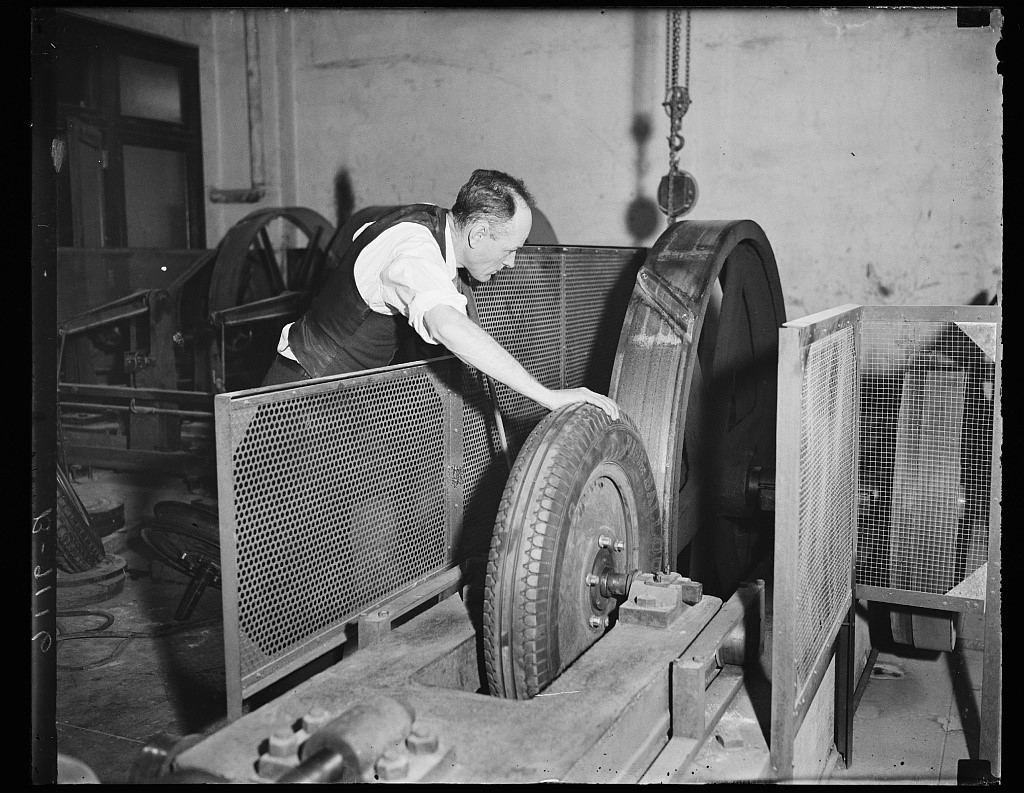
Harris & Ewing, photographer. Tire testing, Bureau of Standards. The Library of Congress.

What’s new?

The US National Institute of Standards and Technology (NIST) published a paper comparing the ability of five photon detectors to produce a measurable outcome when hit by a photon, that is, a quantum of light.  

Minnesota recently became the first state to adopt IEEE 1547-2018, a standard from the Institute of Electrical and Electronics Engineers that describes criteria for the interconnection of electrical power systems and distributed energy resources.

Harold O’Connor, a goldsmith from Salida, Colorado, is the author of The Jeweler’s Bench Reference.

What does it mean?

Improved photon detection is important in the development of lower dose imaging of human tissues and in quantum cryptography to improve the security of data networks. The ability to accurately count photons may eventually form the basis for a new standard for measuring optical power.

The future of the electrical grid will involve energy generation and storage in many locations and from many sources, including renewable energy such as wind and solar; the safe, reliable, and efficient management of such a grid requires standards for the electrical interconnection of these many sources.

O’Connor’s book is a standard reference for jewelers because it includes clear descriptions of jewelry methods.

What does it mean for you?

Whatever technology your organization relies on, someone has already developed or is developing standards. You don’t have to go it alone; you don’t have to reinvent the wheel; some very smart people have thought through how to apply the technology and often that information is freely available. With any new technology, you should ask this important question: is there a standard for this technology?  

For example, a manufacturer of helmets for skiing or snowboarding may want its products to meet the ASTM F2040 standard, which includes requirements for strength and stability. The standard also refers to other ASTM standards that specify testing methods. ASTM, formerly known as the American Society for Testing and Materials, publishes voluntary standards, and has a range of membership options with the highest level allowing participation in technical committees. New standards are being developed by ASTM for gym equipment, mechanically stabilized earth walls, and racket sport eye protectors.

Standards exist for many technologies, but also for any situation where people agree on a procedure or where people want to use a procedure developed by experts. For example, Generally Accepted Accounting Principles (GAAP) were developed by the Financial Accounting Standards Board, which “is recognized by the Securities and Exchange Commission as the designated accounting standard setter for public companies.”  Those concerned with financial accounting can participate in the actions of the FASB by seeking appointing to various committees. The FASB activities are overseen by a seven-member Board which seeks to foster independence and the public interest.

As shown by this example, standards are usually set by an industry supported organization, in which members of that industry can participate. That organization may be recognized by governments as the appropriate entity to set those standards. That same organization or other organizations may audit and certify adherence to the standards. Clients or customers may want the products or services they buy to adhere to those standards.

In your particular business, professional magazines and organizations should keep you informed about relevant standards, but for a function that is not central to your business you may not be aware of the existence of relevant standards. For example, the ISSA (originally the International Sanitary Supply Association, now the Worldwide Cleaning Industry Association) is a source for cleaning standards, audits, and corrective actions. Does your janitorial service adhere to such an industry standard?

Many standards are voluntary while others are prescribed by governments, as with Minnesota’s adoption of the IEEE standards, which I cited at the beginning of this article. Even voluntary standards may be effectively required for being involved with commerce in certain industries. ISO 9001 certification (the certification for an organization’s quality system) is widely perceived as required for international trade. Mead Metals states that obtaining ISO certification in 1998 “was a key factor in expanding the company’s national and international customer base.” Even if not an official standard set by any organization, your technology may have widely accepted standards, such as O’Connor’s book on jewelers’ techniques.

Some standards are not freely available. The IEEE standards must be purchased, as must standards from ISO, the International Organisation for Standardization, which works with 164 international member organizations and has created and published 22,919 international standards, on topics from assistive products to zinc alloys. ANSI, the American National Standards Institutes, is the US member organization. For some standard setting organizations, selling copies of the standards is an important source of revenue to support the work of setting standards.

The dark side of standards is the saying: “Standards are great; everyone has one,” as illustrated in this XCSD cartoon.  While standard setting bodies want to portray the process as benefiting the public good, standards can create winners and losers, and thus are often the result of power politics. Standard setting for the Internet has been a contentious process and the development of standards for the new  cannabis industry is still at the beginning stages. My father (a systems engineer at Bell Labs) told me stories about his endeavors at CCITT (the international standard setting body for telephony), including the determination of the international standard for the shape of the hash tag or octothorpe symbol on the telephone keypad.  

Where can you learn more?

The NIST article on photon detectors is “Calibration of free-space and fiber-coupled single-photon detectors,” by Thomas Gerrits, Alan Migdall, Joshua C Bienfang, John Lehman, Sae Woo Nam, Jolene Splett, Igor Vayshenker, and Jack Wang.

IEEE standards are available here, ASTM standards here, and the ISSA Clean Standard here.  Harold O’Connor’s book The Jeweler’s Bench Reference is available here. The International Organisation for Standardization (ISO) has technical committees in many areas.  Also see their list of other bodies developing standards or guides.

In exploring for this column, I discovered two books I now have on my reading list:

New materials and sensors everywhere

What’s new?

Researchers at the US National Institute of Standards and Technology (NIST) have added a fluorescent material to fiber reinforced plastics to enable the detection of damage to the material over time.

What does it mean?

Fiber reinforced plastics are one type of composite material increasingly used to make lightweight strong components, such as airplane, automobile, boat, and building components. Fibers (carbon and glass are commonly used) are embedded in a plastic material, called a matrix, sometimes with the fibers aligned to add strength.

While such composites offer many benefits, they can deteriorate over time as the matrix and embedded fibers separate. In a 2005 incident, the rudder on an Airbus 310 broke off during a flight due to such separation. The pilots were able to recover control of the plane and land successfully with no injuries to occupants. Visual inspection had not detected any problem with the rudder. Other issues may have been involved in this incident, including a change in the sensitivity of the control system and possible aggressive use of the rudder by the pilot.

The NIST researchers have added small molecules, called mechanophores, that fluoresce after the impact of mechanical force such as what occurs when tiny cracks appear between the fiber and matrix. Fiber reinforced plastics with mechanophores can then be easily scanned for interior cracks. NIST cites the possible use in detecting cracks in wind turbine blades.

What does it mean for you?

The new technology highlights progress in materials, trends toward embedded sensors, and the always present need to consider the people in the system.

All engineered materials are composites. Consider concrete, made from cement which is “manufactured through a closely controlled chemical combination of calcium, silicon, aluminum, iron and other ingredients”, then mixed with water and other materials, and cured into a hard, rock like substance which humans have used for thousands of years. Useful metals (steel, aluminum, cast iron) are all alloys, with different alloys in different quantities yielding metal alloys with different useful properties. Even a wood I beam is an engineered product, with solid sawn lumber joined to board made by using adhesives and compression to solidify layers of wood strands. Progress in almost every field of technology depends on advances in materials. Increasingly physics and chemistry are supplemented by biology, for example in organic photovoltaics, hemp reinforced plastics, and organic-inorganic composites in biomedical applications. Advances in the science and engineering of composites are improving the technology that will enable decarbonization of the economy through renewable energy for generation of electricity and through improved energy storage.

In automobiles, the transition from carburetor to fuel injection, the addition of emission controls, and improvements to occupant comfort all rely on the ubiquity of sensors and computation. The Internet of Things and Industry 4.0 incorporate the exchange of data and the increasing use of computation, but the first requirement is always sensors to collect the data. Sensors can measure light, heat, pressure, motion, sound, moisture, magnetic field, and in fact almost any physical property.  Sensors can replace, literally, the canary in the mine to keep people safe underground and remote sensing from a satellite in space can be used to assess crops on earth.

No matter what field your organization is in, I guarantee that new materials and increasing use of sensors is affecting and will continue to affect your field. Many advise consumers not to buy the first year of a redesigned car and an issue with new technology is to find that sweet spot between being the early adopter (said to be at the bleeding edge) and being the laggard. I tend to be a late adopter (I was the last person I knew to buy a microwave), but you need to think about the technology strategy for your organization. What are the key types of technology that drive your organization? Who is monitoring the environment for new advances in that technology?

Finally, some evidence in the Airbus 310 incident indicates that pilots had not be told enough about changes to the rudder and potential interactions with how the pilot might use the rudder. The application of radar in World War II is a well known story about how technology supported war efforts, but less well known is the role of operations research in improving the use of radar by improving the operators’ techniques. Any technology is part of a system of technology and human; the use of the technology by the humans can amplify or undermine the usefulness of the technology.

Where can you learn more?

The report by NIST is here.

Mostly we engineers are going to take care of these developments for you. Scientists and engineers working on new materials publish in many journals. The NIST researchers published their work in the journal Composites Science and Technology. Recently published articles in that journal covered topics such as the behavior of 3D braided composites at high temperatures, prediction of the fatigue life of a specific type of laminates, and methods to improve the strength of the interfaces of carbon fiber-epoxy composites.  

You can track the implications for your field through your own professional associations by making sure your organization monitors new products, through industry publications and meetings. I love learning about these new developments, so for over 50 years, I have read New Scientist, a weekly magazine with mostly very short articles on developments in all fields of science and technology. For example, an April article describes the use of vanadium dioxide, with added tungsten, printed in a grating to make smart windows that adjust to control how much light is emitted during the day. Blocking heat from near-infrared light reduces the cooling needs of building fitted with such windows.

Makers

What’s new?

The most recent issue of Make magazine (Summer 2020) has articles about making PPE for COVID-19 protection, a backyard wind turbine, and a robot monkey. It also has articles with information about capacitors, wood glazes, and MIDI (Musical Instrument Digital Interface). 

What does it mean?

Make magazine (available for free online or by subscription in print) publishes articles about how to make things. The long history of tinkerers, artisans, and crafters, in the past nurtured by Popular Mechanics, Erector sets, Edmund Scientific kits, and craft stores has morphed into the maker movement. The maker culture is inclusive and eclectic, emphasizing the participation of everyone. The Maker Movement Manifesto by Mark Hatch highlights nine verbs: make, share, give, learn, tool up, play, participate, support, and change. Makerspaces in schools, libraries, universities, and even street front locations provide space, tools, equipment, and community to support makers.

As a retired professor of engineering, I embrace the maker movement because it encourages involvement and fun. I think the movement can recruit young people into engineering. But I also cringe at the lack of understanding that can result. I have had elementary school students tell me that they have made a robotic arm (“we already did that!”) just like the one that took our senior engineering students a whole semester to design and make. Of course, the elementary school robotic arm is nothing like the college robotic arm, but try to explain that to excited sixth graders. Should I even try? Worse perhaps are the inventors who have invented perpetual motion machines (or the equivalent) and refuse to be taught about the laws of thermodynamics. Should I even try?

Good maker culture encourages experimentation and understanding. My strategy in teaching engineers is to start with an example and then extract the theory; that method of teaching requires using a good example, one that can be grasped with some common sense and intuition but one that is also deep enough to enable me to generalize from it and to draw out the underlying physics and math. The Make article on capacitors in the Summer 2020 issue starts with simple experiment involving discharging a capacitor to light an LED and then recharging the capacitor. Then the author (Charles Platt, author of Easy Electronics) explains how a capacitor works, including circuit schematics and an explanation of the difference between a battery and a capacitor. The explanations will be beyond some readers, will elevate or solidify understanding for others, and may prompt some to learn more.

Having stuff available to play with is a strong part of the maker culture. When I was a child in the 1950s, my father worked for Bell Labs, which had the policy that employees could take stuff home, so I had access to and played with batteries and electrical components, supplemented by kits from Edmund Scientific, and Erector sets. I also learned to sew on my mother’s sewing machine. I majored in math in college, but then went on to graduate school in engineering. A maker culture can nurture engineers.

What does it mean for you?

Education, especially in engineering, should be fun. And education in engineering has to be grounded in theory. Hands on with mind involvement. If you interact with children, make sure you give them those messages, in words and in actions. For example, the many excellent programs of the Boys & Girls Clubs of America (I am on the board of directors of the Boys & Girls Clubs of Pueblo County) include DIY STEM, with components on energy and electricity, engineering design, food chemistry, and the science of sports.

As the maker culture and maker movement have spread, schools have incorporated hands on activities in STEM (or even STEAM, adding the A for Arts) into all levels of education. When the students from those programs reach the workforce and college, how do they change the established cultures in those organizations? Universities are learning that telling a student to take 20 credits of calculus and physics before you think about having any ideas is increasingly unacceptable. Engineering programs use introduction to engineering courses, just-in-time teaching, and makerspaces to try to keep the fun and enthusiasm alive. I tell students that calculus is the foreign language they need to come into engineering land and just like learning any foreign language, it is easier to learn when you are using it to accomplish some task.

Maker culture is also spreading into the organizations that employ the products of this culture. Can useful employees emerge from this maker culture? Yes, of course. Hands on, self taught technicians can be valuable, but a backyard welder may need some education and training to become certified. The certification should reflect the tasks the welder needs to do, but for all welders, safety practices must be taught and adhered to, reflecting the importance of safety in all organizations. And you need to think about how to test the ability of any employee to apply their knowledge outside of routine tasks if you expect them to do that on the job. Maker motivated engineers still have to learn the physics and math to understand how devices work.

More broadly, the culture and values of makers may have positive influence on your organization. Makers want to try ideas out in physical things, are willing to fail and try again, want and give critical evaluation of prototypes, and believe in educating and involving everyone. How would those traits work in your organization?

Where can you learn more?

A great place to start is Mark Hatch’s book The Maker Manifesto, which expands on each of the nine verbs I listed earlier.

Luminary Labs urges organizations to embrace the maker culture by getting exposure to maker culture, bringing making inside, and investing in a future of makers. Wired argues for the adoption of maker values: be open, embrace imperfection, love the process, and build community. Simmi Singh in the MIT Sloan Management Review says we need to embrace makers, not just entrepreneurial innovators, by embracing the creator identity, fostering interaction among creators, insisting on fluidity, and understanding the effectiveness of novel play. The company Stanley Black & Decker has developed an array of programs to empower makers.

Explaining AI

What’s new?

The Information Commissioner’s Office (in the United Kingdom) issued its first draft regulatory guidance into the use of AI (artificial intelligence). One part of the guidance advises organizations to “make your use of AI for decision-making obvious and appropriately explain the decisions you make to individuals in a meaningful way.” This guidance applies to decisions that use personal information to make a decision with legal or similarly significant effects.

What does it mean?

Many methods in artificial intelligence use large databases to generate a mathematical model that fits the data well. The model is not built up from knowledge from human experts, but rather by finding the mathematical patterns in the database. The mathematics is very complicated in order to capture patterns not obvious even to the humans who were involved in generating the data. The resulting model can then be used to make a prediction about a case not included in the original database.

For example, artificial intelligence could use a large database on a bank’s decisions whether to grant loans to create a mathematical model that would, with great accuracy, duplicate those previous decisions. Then the model could be used by a loan officer who inputs data on the current applicant in order to generate a recommendation on whether to grant or deny the loan. In most cases, the human being (the loan officer in this case) could still make a different decision than that recommended by the model, but in the future, the decision could be totally automated with no human intervention.

The mathematical models used in such an approach to artificial intelligence are often quite sophisticated and complicated. The result is that the model is so dense that it is difficult to generate an explanation of the prediction in a traditional sense. While a bank might previously have said, “we denied your application for a loan because of your bad credit rating, the lack of collateral, and the poor forecast for growth in your line of business,” with an AI model, the bank might only be able to say that the model generated a low score. Some fear that the mathematics may be capturing biases in past decisions, for example, denying loans to racial minorities that would be granted to other applicants.

Fairness and transparency argue that someone denied a loan should be able to receive an explanation of the decision. Thus, regulators are pushing for (1) transparency so that the person knows that a model was used to deny the loan and (2) explanation of the decision.

Issues raised by these requirements include defining what is an adequate explanation (not simply “the computer said so”) and deciding who is accountable for a decision (the loan officer can’t say “the computer made me do it”). Without an understandable explanation the person denied a loan cannot appeal, cannot correct incorrect data that drove the decision, and cannot improve the important factors so a future loan will not be denied.

The proposed guidance describes several types of explanations: rationale explanation (the reasons for the decision), responsibility explanation (who was involved), data explanation (what data was used to train the AI), fairness explanation (what steps were taken to eliminate bias and ensure equity), safety and performance explanation (steps taken to ensure accuracy, reliability, and security of decisions), and impact explanation (the impact of the use of the AI system more widely on society).

What does it mean for you?

The guidance described above is only proposed and only affects the United Kingdom. However, it indicates a possible trend in other countries. You may find that any AI application used by your organization may need to meet such requirements in the future. Using an AI application that cannot give meaningful explanations may open your organization to legal challenge of bias.

But, more importantly, you should consider the need for your customers and clients to trust your organization not to treat them capriciously. You may not be able to be completely open about the basis for decisions even without an AI element, for example, if you need to protect some competitive secrets, but starting with the premise of explaining decisions to your customers is part of a customer focus for your organization.

Where can you learn more?

The three parts of the ICO report are available here: https://ico.org.uk/about-the-ico/ico-and-stakeholder-consultations/ico-and-the-turing-consultation-on-explaining-ai-decisions-guidance/

The 34-page “Part 1: The basics of explaining AI” is very readable and could be the focus of a discussion in your organization of principles you want to use concerning AI. “Part 2: Explaining AI in practice” is 108 pages and gives more concrete guidance to an organization about the decisions to be made in deciding what type of explanation to provide. Finally, “Part 3: What explaining AI means for your organization” covers organizational roles, policies and procedures, and documentation in 23 pages. While the three parts are oriented toward organizations (rather, organisations) in the United Kingdom, much of the advice applies in any country.

Source info: New Scientist, issue 3259, December 7-13, 2019, page 10. By Adam Vaughan

Businesses and other organisations could face multimillion-pound fines if they are unable to explain decisions made by artificial intelligence, under plans put forward by the UK’s data watchdog today.

The Information Commissioner’s Office (ICO) said its new guidance was vital because the UK is at a tipping point where many firms are using AI to inform decisions for the first time. This could include human resources departments using machine learning to shortlist job applicants based on analysis of their CVs. The regulator says it is the first in the world to put forward rules on explaining choices taken by AI.

About two-thirds of UK financial service companies are using AI to make decisions, including insurance firms to manage claims, and a survey shows that about half of the UK public are concerned about algorithms making decisions humans would usually explain. AI researchers are already being called on to do more to unpack the “black box” nature of how machine learning arrives at results.

Simon McDougall of the ICO says: “This is purely about explainability. It does touch on the whole issue of black box explainability, but it’s really driving at what rights do people have to an explanation. How do you make an explanation about an AI decision transparent, fair, understandable and accountable to the individual?”

The guidance, which is out for consultation today, tells organisations how to communicate explanations to people in a form they will understand. Failure to do so could, in extreme cases, result in a fine of up to 4 per cent of a company’s global turnover, under the EU’s data protection law.

Not having enough money or time to explain AI decisions won’t be an acceptable excuse, says McDougall. “They have to be accountable for their actions. If they don’t have the resources to properly think through how they are going to use AI to make decisions, then they should be reflecting on whether they should be using it all.” He also hopes the step will result in firms that buy-in AI systems rather than building their own asking more questions of how they work.

Produced in conjunction with the Alan Turing Institute, the guidance is expected to take effect in 2020.

Openness

What’s new?

According to ZDNet, sometime in March, someone accessed a Microsoft employee’s account at GitHub and downloaded about 1200 private repositories. The person threatened to publish some of the stolen material online, but Microsoft employees said that the material accessed is not sensitive.

What does it mean?

Because most software projects are large and complicated, programmers work in teams, reuse code from previous projects, and update existing code when problems are detected by users of the product or when new features are added. Created in 2005 by Linus Thorvalds (who also created the widely used Linux operating system), Git is a tool that supports version control, that is, it tracks all the changes that have been made to a piece of code (or any file), allowing restoration to earlier versions if problems arise. Git can track the branching and merging of versions by different users, thus supporting team work on a project. GitHub, one of several hosts for Git, was founded in 2008 and acquired by Microsoft in 2018 for $7.5 billion. GitHub is used by many companies for the development of proprietary products, but is also used by teams developing open source software.

What does it mean for you?

Computer security is a constant problem. While the ZDNet article does not say so, the case may be one where someone obtained the login information of a Microsoft employee. Often the human is the weakest point in computer security, even if that issue was not the case here. I recently heard from a company that about half of their incoming email is rejected by various filters; that percent has increased since the COVID19 crisis has kept people at home. Not all of those emails are attempts to obtain information, but a significant proportion are. A hospital in my community is still recovering from a ransom situation regarding their software. You already know that you need professional help to maintain the security of your computer systems.

Software projects are huge and complicated. While counting the number of lines of code in a piece of software is only a poor measure of the size or complexity of a project, it does enable some comparisons. The infographic “How Many Millions of Lines of Code Does It Take?” shows that the Space Shuttle software has about 400,000 lines of code, the Hubble Space Telescope several million lines, the Android operating system about 12 million lines, and Facebook over 60 million lines of code.

Coding is teamwork. Because of the size of the projects, a team of programmers writes and maintains the code. Software development methods aim to ensure that the resulting software meets the needs of the clients, just as with any other product. These methods have built upon and contributed to ideas about teamwork and customer satisfaction. For example, some software development methods are called agile and focus on being able to handle changing requirements by close collaboration with the customer. The tensions among speed to produce working software, responsiveness to the customer, creating clear documentation, and ensuring that different parts of the software are compatible are issues that every team will recognize. Different methods of software development involve different levels of up-front planning, meetings to review progress at various levels of frequency, sizing of tasks assigned to each programmer, frequency of contact with client, and methods for finding and fixing bugs in the software.

Coding is iterative. James Michener is often cited as the person who said “I’m not a very good writer, but I’m an excellent rewriter” and many writers would express a similar sentiment. Software companies often emphasize speed to market in order to capture market share; features can be added and problems fixed in response to feedback from customers. DevOps is a set of practices designed to provide software updates at a blistering pace and software updates are almost constant with many products.

As a writer and an engineer, I struggle with the programming approach of putting out a product that is good enough, letting users give feedback, and then improving the product. This piece I am writing now will reach a final stage and I will post it.  Many engineering products (bridges, for example) have safety requirements built in from the start and are not meant to be strengthened or rebuilt in response to failure. Starting with a “minimal viable product” for, say, an autonomous vehicle shocks me and makes me conscious of the ring I wear on my right pinky.

The most interesting aspect of this story for me is that many of the users of GitHub are working in teams to produce open source products. The first and still the most famous example of open source software is Linux, software for the Unix operating system. Open source software may be used, changed, and distributed to others under a license specifying the terms. The open movement has many flavors and philosophies combining in various ways community, sharing, transparency, inclusivity, peer review, the value of public goods, giving software away for free, and protection of intellectual property rights. The words “free,” “open,” and “libre” are used in specific, although not always consistent, ways to make distinctions.

Open source software has led to other concepts of open, such as Open Educational Resources. I have written two textbooks (one an introduction to industrial engineering and one on probability, statistics, and Six Sigma) that I give away for free. I have taught students well and saved them tens of thousands of dollars. I took this approach to my books because it freed me to write the books I want (not the books that publishers think I should write). I distribute the book under a Creative Commons license, which specifies what users may and may not do with the text. One of the books has been translated into Turkish and has also been recombined with material written by another professor for use in her classroom. Many examples of Open Educational Resources are collaborative efforts.

The open movement is increasingly being applied in other domains. Wikipedia, citizen journalism, the open wireless movement, and an open source group for watch making are just some examples.

The open movement challenges our thoughts about how work should be done. The highly paid professionals behind some of the most highly valued companies are part of community that argues about how to work together to create their products; many of them have concluded that open and collaborative work is better than closed and individual work. Furthermore, the open movement challenges our thoughts about the nature of labor, pay, and the common good. Some open source software is produced by people who work for pay, but in other projects all the work is done by unpaid people. Why do people do this work? Because people want to be part of something larger than themselves and people want to work on something that feeds their passion. In an economy in which almost everyone survives by selling their labor, what does this movement mean?

As we talk about returning back to normal during the COVID19 crisis, I argue we should be talking instead about moving forward to better. The economic system of the US is a mechanism for organizing work and for delivering products and services to people. Other mechanisms are possible and the open movement may give us some ideas.

Where can you learn more?

The 1999 book The Cathedral and the Bazaar by Eric S. Raymond contrasts software development under tight control with software development in the public eye, arguing for the latter based on, for example, the observation that involving more people leads to quicker detection of bugs in the software.

The 2008 book Two Bits by anthropologist Christopher M. Kelty argues that the Open Software movement created a new type of entity, a recursive public. “A recursive public is a public that is vitally concerned with the material and practical maintenance and modification of the technical, legal, practical, and conceptual means of its own existence as a public; it is a collective independent of other forms of constituted power and is capable of speaking to existing forms of power through the production of actually existing alternatives.” The geeks he study both act within the open source movement but also consciously work to preserve the environment that allows the open source movement to exist.

The Electronic Frontier Foundation defends “digital privacy, free speech, and innovation.”

“The Free Software Foundation is working to secure freedom for computer users by promoting the development and use of free (as in freedom) software and documentation.”

The Open Source Initiative provides various licenses for open source software.

Open Education Global is a consortium of organizations supporting open education.

Making masks

What’s new?

In an effort to help people during the COVID-19 pandemic, many makers have applied their knowledge and technology to make Personal Protective Equipment (PPE), especially face masks, and to make medical equipment that is in short supply in some places, especially ventilators. The Center for Disease Control (CDC) provides advice on how to make a mask, including a no sew alternative from an bandanna. ActivArmor, a company making 3D printed casts and braces in my home town of Pueblo pivoted quickly to making 3D printed FDA compliant fitted face masks.  GM partnered with Ventec Life Systems to produce ventilators, delivering the first products in mid April.

What does it mean?

Making a fabric face mask requires some thought. Tightly woven fabric or multiple layers do best at filtering out small particles. Loosely woven or stretch fabric have larger holes that allow viruses through. Adding a filter from items available in many households (for examples, coffee filters) may or may not help and may expose the human to other unsafe fibers. The mask needs to fit snugly to prevent air from getting around the edges. Masks should be washed regularly. The wearer should be cautious about touching the mask to adjust it, possibly transferring virus between the hands to the face. But even with those cautions, any face mask may be better than none, at least at preventing the wearer from transmitting the virus to others.

Masks intended for use by medical personnel require even more thought. The FDA describes the differences among types of surgical masks (surgical, isolation, dental, or medical procedure masks). These are meant to be used once and disposed of. Surgical N95 respirators are designed to block “at least 95 percent of very small (0.3 micron) test particles.” The FDA (working with CDC NIOSH) regulates these items. These regulations rely on ASTM standards concerning bacterial filtration efficiency, particulate filtration efficiency, fluid resistance, pressure differential, and flame spread. An ISO standard applies for skin sensitivity and cytotoxic tests “to ensure that no materials are harmful to the wearer.”

Ventilators are sophisticated devices that deliver air to a patient’s lungs, and include controls, monitors, and safety devices to make sure the device is helping, not harming, the patient. Initial excitement by makers cooled down when people realized the difficulty of making a safe and useful ventilator.

What does it mean for you?

The lessons to be learned are about materials, processes, technology, and safety. The biggest lesson is about expertise. Meaning well is sometimes hard to translate into doing well.

Kaoru Ishikawa, one of the founders of Japanese quality, invented the Ishikawa (or fishbone) diagram, in which the causes of a problem in quality are brainstormed and displayed, often in six categories: Man (people), Machine, Material, Method, Measurement, and Mother Nature (environment). The design and manufacture of any product or service has to consider these factors in depth in order to reliably deliver.

People who will do the work must be trained completely. Machines and equipment (including computers) used in production have to be capable of producing products and services meeting the specification of the customer. Materials must be chosen that can stand up to the uses to which they will be put. Methods of production have to be refined and standardized so the desired quality is achieved every time. The measurement devices used in every step must be capable of measuring the desired critical-to-quality measurements. And consideration must be given to how to control the natural variation in the environment so quality is not harmed.

In the face of the global pandemic, it has been heartening to see so many people step up to help – helping their neighbors with food, helping by slowing the spread of the disease, and helping to produce products to support medical care. But designing a product or service and designing the production process to reliably produce that product or service to meet the desired specifications are hard work – and require expertise. The final story about the world’s response to COVID-19 is a long way from being written, but certainly the ongoing battle between respect for and rejection of expertise and the need to identify who actually has expertise will be parts of that story.

In your organization, you provide leadership – in the many forms that can take – but you know that you must select and listen to experts that you can rely on. My field, industrial engineering, provides the expertise you need for producing services and products to meet customer specifications – reliably and consistently. Industrial engineering sometimes seems like organized common sense, but common sense is, regrettably, not always that common, and a task that may seem easy can, in fact, be hard. As I watched the initial efforts to make PPE and medical equipment, I was warmed by the enthusiasm and the desire to help, but dismayed by my knowledge that those efforts would, inevitably, need to be refined and perhaps even abandoned. Meaning well is sometimes hard to translate into doing well. Experts do know more than nonexperts.

Where can you learn more?

Industrial engineering is about efficiency, quality, and safety. It has roots in methods invented by Taylor and the Gilbreths that became time-and-motion studies, mathematical methods of optimization used to improve efforts in World War II that became operations research, quality tools developed by Shewhart, Deming, and others that led to control charts and quality principles, the invention of electronics that led to computers, automation, and controls, and much more. Key ideas are processes, systems, flow, control, optimization, continuous improvement, and safety. Industrial engineers are the engineers who think most about the people. I tell my students that being an industrial engineer means you are always dissatisfied: if it ain’t broke, it can still be improved.

Many professional organizations support the creation and dissemination of knowledge in industrial engineering and the networking of professionals. The lead society for industrial engineers is the Institute of Industrial and Systems Engineers (IISE), which has subgroups for all the specialties withing the field. Other relevant organizations include the American Society for Quality (now called ASQ), the Institute for Operations Research and the Management Sciences (INFORMS), the Society of Manufacturing Engineers (now called SME), and the Human Factors and Ergonomics Society (HFES). If you want to deliver a product or service that meets customer requirements with efficiency, quality, and service, hire the experts: industrial engineers.