“And then?”


A spork
Source: https://commons.wikimedia.org/wiki/File:Textured_spork.png
Licensed under the Creative Commons Attribution-Share Alike 2.5 Generic, 2.0 Generic and 1.0 Generic license.

What’s new?

Several tech columns (for example, this article at INSIDEVS) have commented recently on Tesla’s approach to batteries in which the battery forms part of the structure of the vehicle: a structural battery. Chanan Bos at CleanTechnica likens the approach to the change from fuel tanks in aircraft wings to aircraft wings that are fuel tanks. The wing doesn’t contain the fuel tank; the wing is the fuel tank. Others point out (for example, this article at Wired) that a structural battery is not a new concept. See, for example, this article from 2012.

What does it mean?

A battery stores energy. A structure supports mechanical load. A structural battery does both.

My favorite element, carbon, has properties that may make it useful for structural batteries, as explained in this 2012 article in Smithsonian Magazine about research by Leif Asp. In this 2019 review article, Asp and his co-authors discuss design issues, including selection of materials for different parts of the battery. They note that electrification of transportation depends on better design for batteries and that eventually this research could lead to electric airplanes. Their batteries are not just an assembly of components each with one function, but rather batteries in which every component has multiple functions.

What does it mean for you?

The Institute of General Semantics says “General semantics is the renowned, practical discipline that applies modern scientific thinking and language strategies to solve problems in everyday life.” More definitions are here, including this one from Catherine Minteer: “General semantics provides a method of studying the part language plays in human affairs. It emphasizes the effectiveness of human communication in (1) the awareness of the all-pervasive character of language in daily affairs, (2) the habit of looking to language as a possible clue to some of our misunderstandings and conflicts, and (3) an appreciation of the scientific method and a consideration of applying it to language.”  General semantics is an annoying and useful field of study. Often the statements are simultaneously obvious — even trite – and deep and insightful.

One of my favorite sayings is from Alfred Korzybski, the founder of general semantics: “the map is not the territory,” or, as I often say to engineering students, “it’s only a model.” Do not mistake a map or a model for the real world. The map or the model may lead you to some result, but you need to make sure the result is actually true about the real world. Or in the 1929 art of Rene Magritte, “Ceci n’est pas une pipe” which means “this is not a pipe” and is written on his painting of a pipe, titled “The Treachery of Images.”

D. David Bourland Jr took seriously a suggestion from Korzybski to eschew all forms of the verb “to be” in the interests of clarity. He recommended the use of E-Prime, English without that verb. I tried to do so in this blog, but failed: I couldn’t, for example, quote Korzybski in the previous paragraph without using the word “is.”

I am a fan of Edward MacNeal for his work on applying general semantics in decision making. In a 1986 article titled “When does Consciousness of Abstracting Matter the Most?”, Mr MacNeal cited Korzybski’s critique of elementalism, which means “our splitting verbally what cannot otherwise be split, … a serious structural flaw in language.” In that article, MacNeal deplored the linguistic split between “action” and “consequences” because this split lets us think about action without considering the consequences. He adopted the word “alternaquence” (combining “alternative” with “consequence”) and commented “If you ask me what my alternaquences are, that sticks me with the responsibility for what follows, doesn’t it? ‘Well, Ed, what are your alternaquences?’ Do you hear it? There’s no place to hide.” He stressed that decision making about alternaquences requires one to develop powers of forecasting simply by asking “and then?” One of my specialties, decision analysis, involves the use of decision trees to describe a decision situation, looking forward into time with decision nodes and chance nodes. Creating a decision tree requires exactly that outlook and exactly that question: “and then?”

Battery. Structure. Elementalism means we engineers long ago created those two separate concepts and we use the two words to keep their functions separate. “Structural battery” removes the split, a simple yet profound linguistic change. It makes me smile.

What words in the language that you use keep separate concepts that can, and maybe should, be combined?

Where can you learn more?

General semantics was first described in the book Science and Sanity: An Introduction to Non-Aristotelian Systems and General Semantics, 1933, by Alfred Korzybski. Other significant roots include S. I. Hayakawa’s Language in Action, 1941 (the 1995 version is titled Language in Thought and Action), the linguistic theories of Benjamin Lee Whorf (the structure of a language affects how the speakers of that language think), and work in cognitive science and linguistics by George Lakoff (our metaphors and framing affect our thinking). The Institute of General Semantics publishes a quarterly journal, ETC: A Review of General Semantics.

Reduce, reuse, recycle, but first redesign

“Woman’s clothing being modeled at the spring fashion show of the National Retail Garment Association in the Hotel Commodore, New York City,” 1921. Source: Library of Congress, https://www.loc.gov/pictures/item/95501716/. This photograph has no known restrictions on publication.

What’s new?

The collar on one of my partner’s favorite shirts was wearing out, so I recovered the collar with similar fabric and it looks quite nice. The popular European fashion store H&M has created its first in-store center that shreds old clothing to create yarn, then fabric, and finally new clothing. The fashion industry has been cited as being second after the oil industry for creating pollution. Also noted is that “we as consumers can impact the environment by making smart decisions on how and where we shop.” Tech Crunch reports that Thousand Fell is one of several shoe manufacturers “that are experimenting with various strategies to incorporate reuse into the life cycle of their products.” They also note that several companies offer recycling of denim clothing.

One of my favorite tech web sites, Modern Machine Shop Online, has a new post on “The Circular Economy, Sustainability, and Recycling.”

What does it mean?

Probably arising about the time of the first Earth Day in 1970, the phrase “Reduce, Reuse, Recycle” reminds consumers of three strategies for reducing waste and reducing environmental harm.  The first strategy is, of course, to reduce consumption: just don’t buy more clothing. Several bloggers have written about a year with no new clothes (“or at least no `new-new’ clothes”): here, here, and here (two years!). Lessons learned: take care of your clothes and they will last longer, not buying clothes becomes easier over time, and it is easy to do if you start off the year owning a lot of clothes. Irony abounds, however, in the plethora of Earth Day clothing and other swag that you can buy.

Reuse of clothing is increasingly chic with many sites that will give you ideas for upcycling clothing yourself (here, here, and here, for examples) or other sites that will sell you upcycled clothes. I never knew my father’s father, who was a tailor, but I learned to sew early and still enjoying doing so. The maker movement supports people in discovering the pleasure of making – or remaking – as an alternative to buying (but the success of stores like Michael’s, Hobby Lobby, and Joann’s makes clear that making involves a lot of buying). Used clothing has had a fashion resurgence with companies like thredUP.

But consumers can only do so much. Searching for and buying cotton clothing where the cotton fabric is grown in an environmentally sound way (growing cotton takes a lot of water) and then is sewn in a socially responsible way (the fashion industry is accused of being a leading exploiter of workers) leaves little leeway for considering whether one even likes the resulting clothing. Hemp fabric and clothing are arguably more environmentally friendly, but not yet as available, and also more expensive. I used hemp fabric to recover the collar of my partner’s shirt. And this whole paragraph (even the whole post) reeks of privilege: I am lucky enough to be able to implement a self-imposed ban on shopping at Walmart and Amazon because I abhor their social impacts. Buying green is often more expensive. What are real people supposed to do, Jane?

If the choices aren’t offered by the market place, what is a consumer to do? Those “Reduce, Reuse, Recycle” strategies are always targeted at consumers; the EPA’s advice omits any reference to the role of manufacturers. On the other hand, pity the manufacturers who produce products that are better for the environment and can’t get people to buy them. So some go back to more sophisticated ways to motivate “the elusive green consumer” and others take on the task of persuading consumers that green products actually do work. An argument can be made that changing the behaviors of the few, extremely wealthy people would have the largest effect on reducing environmental harm.

The situation is, of course, typical of a systems approach: the best strategy is not a single strategy. It’s not “or” but rather “and.” Consumers need to reduce, reuse, and recycle; they need to purchase more wisely when they do, but manufacturers and retailers also need to do their part: stop selling environmentally disastrous products.

What does it mean for you?

The Modern Machine Shop Online article has some advice: think circular, not linear. We cannot continue to dig stuff out of the ground, use it, and throw it back in the ground; we need to reuse the stuff we dig out of the ground. The key to circularity, they argue, is the design phase. Using an example from Steelcase business office furniture, MMSOnline describes how design decisions can support a reduction in material use and an improvement in the ease of recycling. They also point out that additive manufacturing is helping make these redesigns possible. Another of my favorite technology topics, new materials, is also relevant, with panels made from recycled products (for example, ECOR) potentially capable of replacing virgin material in construction.

The circular economy is not a new idea, as this 2014 article from Industry Week makes clear.

Where can you learn more?

Modern Machine Shop Online recommends, and I agree, the resources at the Ellen MacArthur Foundation. They describe three principles for the circular economy: design out waste and pollution, keep products and materials in use, and regenerate natural systems. They cite three focus areas for textiles and clothing: new business models that increase clothing use, safe and renewable inputs, and solutions so used clothes are turned into new. They note: “To be able to capture the value of all materials once garments are no longer worn, it is necessary to ensure that design aligns with recycling processes that are available today.” The Ellen MacArthur Foundation supports the initiative Make Fashion Circular.

An article at Forbes expresses skepticism about the potential impact of such changes and, with good reason, advocates for simply less: “In the fight for our future, the fashion has to be circular but first and foremost it has to slow its growth, forecast what shoppers actually want and cut the overproduction.”

The word “circular” or the phrase “circular economy” coupled with the name of your industry sector may uncover helpful resources, as in “circular fashion.”

Your organization’s resonant frequency

Source: https://commons.wikimedia.org/wiki/File:Wave_Sinusoidal_Cosine_wave_sine_Blue.svg
This file is licensed under the Creative Commons Attribution-Share Alike 3.0 Unported license.

What’s new?

As reported in MMS Online on 2 October 2020, in partnership with Oak Ridge National Laboratory, MSC Industrial Supply Co technicians have been trained to use a so-called tap test to determine the optimal speed at which a CNC mailing machine or machining center can be operated. It is hoped that widespread use of this technique will enable these machines to operate at higher speeds, thus increasing the capacity of the estimated 30,000 machine shops in the US.

What does it mean?

Vibration, oscillations, and repeated motion are fundamental concepts in engineering because they describe so many physical phenomena. A struck bell emits a tone because the strike causes the bell to vibrate at a particular frequency and the vibration of the bell causes the air to move at that same frequency, generating the sound that a human hears. A person on a swing goes back and forth at the natural frequency of that pendulum and the amplitude of the motion is increased if the person is pushed at the appropriate time in the swing. I live 10 miles down a dirt road and sometimes a portion of the road will develop a washboard; driving over that portion at different speeds may reinforce or dampen the up-and-down motion of the car.

In 1831, marching soldiers inadvertently marched at the natural frequency of a suspension bridge, which collapsed under them; hence, the command for soldiers to break step when crossing a bridge. For decades, engineering students have been shown a video of the 1940 destruction of the Tacoma Narrows Bridge by oscillations reinforced by wind. The point is to vividly demonstrate to engineering students the importance of considering vibrations.

Picture a rotating tool with several cutting blades.  The tool will be vibrating at its natural frequency. If the tool has moved away from the surface being cut, then the blade takes a shallow cut; if the tool has then moved back toward the surface for the next cut, then the blade takes a deep cut, resulting in reduction in surface smoothness in the machined part. If the vibration and rotation of the tool are appropriately matched, each blade will take the same amount of cut, resulting in a smooth surface. The second video (called MSC MillMax) at this web page illustrates this effect and explains that the tap test is used to determine the natural resonant frequency of the machining center using that tool.

The instinctual response to a mismatch (detected as chatter) is to slow down the rotation of the tool, but that response may not be correct. In the tap test, a small accelerometer is attached to the tool, and it records the vibrations when the tool is tapped. These data are analyzed by software which predicts which speeds are going to be stable in operating the machining center with that tool. With a tap test, the correct rotational speed to eliminate chatter can be determined, often resulting in the ability of the machining center to operate at a higher rate.

What does it mean for you?

First, machines always have vibration issues. These issues may impede production, may lessen the useful life of the machine, and may harm workers. Vibrations from jackhammers are a notorious hazard to humans, but other vibrations also have ergonomic concerns.  It is always worth asking about vibration issues.

Second, when seeking the best settings for a machine, one must be careful not to settle for a local optimum (the best combination of settings compared to small perturbations in settings) rather than obtaining the global optimum (the best combination of settings among all possible combinations). Incremental improvements (for example, making small adjustments in settings until no further improvement occurs) may miss a better solution. This idea may apply in any design situation. Sometimes you need to change everything, not just make small changes, or you will miss opportunities for improvement. Don’t get stuck in a local optimum.

Finally, the article discusses why each machining center must be tested and tuned. Tom Smith, one of the inventors of this process, says, according to the MMS Online article:

“The reality is that most shops are under-using their equipment because they don’t know what their equipment can do. And the reason that they don’t know what their equipment can do is that the performance depends on the whole system that gets put together. It’s the machine tool, and then the tool holder and then the tool. It’s the fixturing. And it’s not until you assemble them all together that you get the system whose performance you’re interested in, right? So, the spindle maker makes the spindle, the machine tool maker makes the machine, and the tool maker makes the tool. And they all sell it to you separately with no idea how you’re going to put it all together. They can’t tell you how to use it. But then when something goes wrong, there’s a big tangled mess. You call the tool maker and they say, ‘Oh no, everybody loves our tools! They worked fine in other places so there must be something wrong with your older machine.’ And you call the holder maker and you call the machine maker and they all say, ‘Everybody loves our stuff!’ And you’re still stuck.” (emphasis added)

Maybe someday someone will invent a tap test for determining the resonant frequency for an organization, but, until then, nobody can tell you exactly how to optimize the system that you have, since every system has unique combination of components that make up a unique system.

Where can you learn more?

The software for the tap test was developed by MLI, Manufacturing Laboratories Inc. The MSC Millmax program is described at this web page.

The MMS Online article places the tap test and its promise for increasing the capacity of machine shops within the larger context of bringing manufacturing back to the US in order to secure supply chains against a future disruption such as the one that has been caused by COVID19.

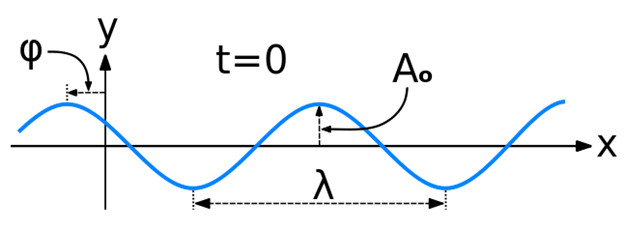
Postscript: My EJB Partners colleague Elliott Ring sent me a link to this video, which shows how metronomes become synchronized; Dr Ring uses this video to talk to groups of people about how teams evolve. Note that this demonstration works because of several important properties of this system: (1) the metronomes have the same frequency (or wavelength); they are out of phase at the beginning and become in phase (wavelength is given by the distance labeled with the Greek letter lambda in the picture at the top of this post; phase is indicated by the time of the trough of the wave); (2) the synchronization occurs not when they are on the table, but only after they are placed on the soda cans; and (3) the metronomes are mechanical devices, not, for example, software generated click tracks. The metronomes synchronize when they are able to exchange mechanical energy with each other (becoming coupled in one system, instead of being separate), through the flexible board, providing nudges to each other. Similarly, one can change the phase of person in a swing by pushing them at a slightly different phase; eventually the swing will adjust.

This work is licensed under a Creative Commons Attribution 4.0 International License.
High class grifters

r/family_history - High class grifters in my tree. Litigious high class grifters.

Genealogy is my hobby and since I am now retired I am spending HOURS tracing my ancestors. I have been working on getting more information on my 5x great grandparents Samuel STEVENSON and Cecilia MILLAR from Scotland. They were, I think, high class grifters. He was a merchant and a Burgess in both Glasgow (1726) and Edinburgh (1742), which is very establishment – being a Burgess was a big deal.

So what did he sell? He made an excellent living selling Anderson’s pills, which seem to be quack medicine. A Dr Anderson developed them in the 17th century from a secret recipe from Venice. How did my Samuel get the recipe? Cecilia, before she married Samuel, worked for the family that made Anderson’s pills and it seems she stole the recipe; she was actually fined and imprisoned for selling the pills in Edinburgh.

Samuel and Cecilia married in Edinburgh about 1722, had 3 children there, then moved to Glasgow, where Cecilia died in 1728. That same year Samuel started marketing the pills. By 1736 he moved back to Edinburgh and in a 1739 ad actually bragged about Cecilia stealing the recipe: “… Tho. Weir only communicated the Secret to his Spouse, who out-lived him; and Mrs. Weir was assisted in making up the said Pills, for several Years, by my deceas’d Spouse, who revealed the Secret to none but myself, after Mrs. Weir’s Death. …”

Samuel traded insulting ads with Mrs Weir; at one point he likened her to a snake. At some point he lost a lawsuit brought by her (I am still trying to get those details). But he made enough money that he left a complicated will with money going regularly to his 5 grandchildren, who ended up suing each other after his death. That lawsuit dragged on for years. It came out in the lawsuit that one of the grandchildren (another Samuel STEVENSON, a surgeon and my ancestor) was not considered fit to administer the affairs of his not-quite-right sister Cecilia, so the cousins had to do it. That Samuel was known to be bad with money apparently.

One of the other grandchildren, Samuel Stevenson GRAHAM, became the Lt-Governor of Stirling Castle (a big deal) and is buried there. His biographer claimed that Cecilia (his grandmother) was related to some posh MILLARs, but I am beginning to suspect she lied because I cannot find that connection (and that MILLAR family is filled with ministers who I cannot believe would associate with my people). An early member of the other MILLAR family was actually the wife of John KNOX. I am not making this up.

Then there is the lawsuit by Ann McILWRAITH against her husband, Samuel’s son Alexander STEVENSON (another surgeon), to declare that the couple actually was married (although there doesn’t seem to be any record). They must have reconciled since they had 5 children (including my ancestor the second Samuel STEVENSON) after that lawsuit. Ann’s father was Andrew McILWRAITH a semi well known portrait artist and a Burgess in Edinburgh in 1735. And Andrew’s wife was Ann MOSMAN, the sister of William MOSMAN, another portrait artist, who some say was of Jewish descent.

There seem to be other lawsuits about various properties owned or in the possession of Samuel and his son Alexander STEVENSON; I am trying to figure all of those out.

I think I have enough material for a TV show. But who would believe it? I hope you find it all as amusing as I do. I just wish my father (who was born in Glasgow) were still alive because he would think this was all really entertaining.

Your organization’s thermostat

What’s new?

Modern Machine Shop Online reported on 18 September that Rigibore’s ActiveEdge wireless boring bars (working in conjunction with sensors) automatically adjust the boring system to reliably produce holes within the desired tolerances for the hole diameter. The automatic nature of this system eliminates any errors due to human adjustments.

What does it mean?

Many parts require a hole to be drilled; the hole must be within a specified tolerance range, that is, the diameter must be greater than a specified lower limit and must be less than a specified upper limit. Reliably drilling holes within the tolerance is necessary for the part to function properly. With an in-process measurement system, each hole is immediately and automatically measured. The measurement is recorded and, if it is out of specified warning levels (that are within the tolerance range) the drilling system is adjusted. The warning levels mean that the most recently produced part is still within tolerance (and the part does not need to be rejected), but the part is nearing the upper or lower tolerance limit.  With the Rigibore system, that adjustment is done automatically; the measurement is sent wirelessly to the cutting system, which automatically makes the correction.

This system of measurement and adjustment is a negative feedback system. If the diameter is too large, the cutting diameter is made smaller for the next part; if the diameter is too small, the cutting diameter is made larger. A thermostat is the same type of system: if the room is too warm, the temperature is reduced by cooling; if the room is too cold, the temperature is increased by heating. You do the same when you drive: if your car is drifting right, you make an adjustment in the steering to head to the left; if your car is drifting left, you make an adjust to head to the right. This feedback is called negative feedback because the system is adjusted in the opposite direction of the detected measurement. A negative feedback system, if well designed, keeps a goal within specified limits.

The article reminds us that accurate measurement is necessary. The article quotes Rigibore’s president as saying “Gage accuracy has to be rock solid.” If your measurement says the room is too hot, but it actually isn’t, the correction made to cool the room may actually cause it to become too cold.

The article reminds us that randomness can occur; as mentioned in the article, a measurement might be inaccurate due to a piece of dirt in the hole. The Rigibore system makes an adjustment only after detecting two measurements outside the warning limits. Feedback systems, if poorly designed, can chase random effects, creating more rather than less variation. Dr Deming’s funnel experiment was designed to illustrate the ill effects of tampering with a system.

The article reminds us that the timing and the amount of adjustment have to be selected carefully. Rigibore has designed the system to make adjustments without increasing the time it takes to bore a hole. The system is also designed to make very small corrections. Overcorrection in driving is well known to lead to accidents.

While the article doesn’t remind us, feedback systems work only if the system being controlled is well understood. The goal must be clearly stated (a hole with diameter within tolerances), the measurement to be made must be clearly defined (the diameter), the measurement system must be accurate (“Gage accuracy has to be rock solid.”), and the action to be taken to correct the system must be well understood (if the diameter is too large, reduce the size of the bore by a small amount).

Negative feedback control is a simple model but its concepts underlie much of engineering. Control charts, one of my areas of expertise, are based on the same concept of monitoring a key performance variable and taking corrective action when measurement indicates the system has deviated from ideal settings. Control charts add the interesting concept of also monitoring and controlling the variation in that key variable.  Reducing variation is a valuable strategy for keeping the variable within limits.

What does it mean for you?

The most important part of negative feedback control is that it is closed control, that is, the system itself is measured before a decision is made on what control to implement. That simple concept may need reinforcing with some who think they can steer without first finding out where they are currently heading.

If an the organization identifies a goal to be kept within certain limits (for example, growth rate in sales, the number of product design changes being implemented, or the amount of emails and other communication being sent in the organization), the organization’s leader can ask for a clear statement of the goal, a clear definition of the measurement, an accurate measurement system, and – the most difficult part – a clear description of the system for controlling the goal. What are the factors that can be used to heat up the room (increase sales) or to cool the room (decrease sales)? What is the time scale on which each of these factors operate? What are the levers that the organization can use to affect those factors? No organization can probably answer all those questions, but the discipline of asking them focuses discussion and research.

The need to have that clear understanding supports the idea that the role of leadership is to study and understand the system that is their organization and the system within which the organization works. Workers work in the system; management works on the system.

The metaphor of control in this simple model may lead some to think that the lesson is top-down management, but the Rigibore system is so successful because the measurement and corrective action have been delegated to the lowest level of control, the actual tool. The people and sensors closest to a key variable must have the authority to measure and control that variable.

Finally, this MMS Online article on Rigibore highlights the importance of definition and measurement. You cannot control what you can’t define and measure. See this explanation from the US Bureau of Labor Statistics on the definition of the unemployed and the employed and, while they are correct to state that the basic concepts are simple, the details are devilish. The BLS itself reports the values of several measurements not just of unemployment but also of underemployment.

Where can you learn more?

The mathematics of negative feedback control is simple and elegant, but also leads to more complicated models. See, for example, this explanation from chemical engineering. Then there is the textbook used for the course in control systems at my former university (Colorado State University-Pueblo), Feedback Control Systems by Charles L Phillips and John Parr, now in its 5th edition.

Feedback control goes by other names. Deming describes balancing loops. Senge’s fifth discipline is systems thinking and his first systems archetype is balancing feedback.

Metaphors are powerful. Contemplating their use can lead one down numerous deep rabbit holes. The Stanford Encyclopedia of Philosophy says: metaphor “has attracted more philosophical interest and provoked more philosophical controversy than any of the other traditionally recognized figures of speech.” Gareth Morgan is the best known proponent of the use of metaphors to understand management, as described in his book Images of Organization, first published in 1986 and revised in 2006.

This work is licensed under a Creative Commons Attribution 4.0 International License.

A picture is worth a thousand words

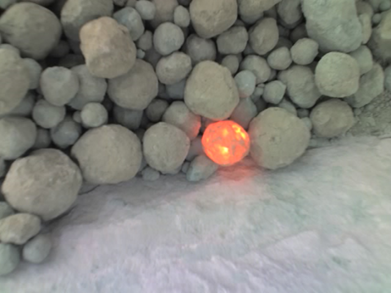
White clinker after kiln exit.
Source: https://commons.wikimedia.org/wiki/File:Hot_Clinker_2.jpg
This photograph is in the public domain.

What’s new?

Thyssenkrupp is a large German construction company that specializes in designing and building production facilities for the chemical, cement, and mining industries. As described in this recent article on their website, thyssenkrupp engineers in Germany recently completed remotely the commissioning of a clinker production line in Guatemala; also thyssenkrupp engineers in India and Germany remotely performed a performance test on a plant in Kenya. Usually these tasks would be done on site, but COVID19 concerns led to remote completion instead.

What does it mean?

A contract to build a large production facility often includes, as one of the final steps, a demonstration that the facility works according to all the requirements in the contract; this step is called commissioning the plant. In addition, the contract may include a bonus payment if the facility can demonstrate its ability to meet a goal substantially beyond the minimum production rate specified in the contract; this step is called a performance test.

The production of Portland cement involves crushing rock of a certain composition, combining it with other material, heating the resulting mix to drive off undesirable gases, thus producing marble size material called clinker. Clinker is ground and mixed with other ingredients to form the final product, cement powder. Some plants may stop at the production of clinker, which can be shipped to locations near where cement is needed and ground into cement there. Shipping clinkers instead of the finished cement avoids “the difficulties of carrying cement powder.”

COVID19 has curtailed travel drastically and made many meetings move from face-to-face to online. People have had to adapt business practices in many ways. Some speculate that business travel may permanently decline, as methods are refined for better remote communication. What does it take to remotely commission or test the performance of such a complicated plant?

In full disclosure, I love Zoom. Being able to attend (and host) meetings with people from all over Pueblo (and further) without having to drive to town (and leave my wonderful home on 53 acres 10 miles down a dirt road) is fantastic. I meet twice a week online with my colleagues Elliott and Bill from EJB Partners; I can’t remember the last time we met in person (probably in March).  But doing well at online meetings requires the right tools. As someone who wears hearing aids, clear sound at sufficient volume is important; I am still experimenting with speakers and microphones and I haven’t found the right headphones that work well for me. Many of us have learned to share screen and to use the chat box for public and private discussion to support the auditory channel during the meeting.

In this case, the thyssenkrupp engineers had to be able to observe and control the operation of the plant in some detail. In the first example, “A virtual control center was set up in Neubeckum, where thyssenkrupp’s commissioning engineers had the same picture in front of them as the customer’s operating personnel in Guatemala.” And similarly in the second case, “In virtual control rooms in Neubeckum, Germany, and Pune, India, the control panel of the plant in Kenya was projected onto huge screens.”

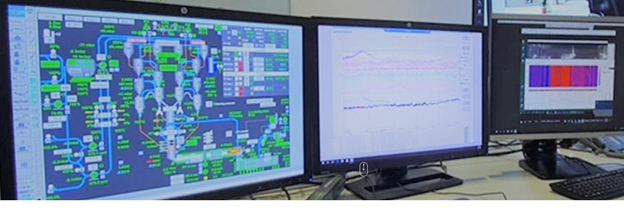
I have reproduced below a portion of the picture at the top of the thyssenkrupp news story.

Source: https://insights.thyssenkrupp-industrial-solutions.com/story/cement-production-remote-performance-testing-and-commissioning-a-successful-first/

While not clear (and perhaps deliberately blurred by the company), the screen on the left can be seen to show a systems diagram for the plant, showing the flow of material and probably also displaying real time values of certain settings controlling the plant (for example, the status of valves) and real time values from certain sensors (for example, temperatures at different points). This systems diagram presents an overview and is probably be supported by more detailed views of portions of the overall system.

What does it mean for you?

A clinker production facility is a complicated device. The picture above represents the shared understanding of how the plant works, including how the material flows and how the parts interact with each other. This understanding reflects the knowledge of engineers and enables them to understand what is happening as well as share that understanding with each other. It is hard to overestimate the importance of this diagram in the ability of the thyssenkrupp engineers to communicate with those in the room with them as well as with those thousands of miles away. The icons, the colors, the lines, etc., all have specific meanings that all the engineers know immediately. Since the team involved in the performance test certainly included native speakers of at least German and Spanish, this diagram is written in a shared language that all understand.

What is the shared diagram for your organization? Creating such a diagram is hard work, even for a physical system such as a production facility; the creation of such a diagram is even harder for a system involving more than physical flows. At its simplest, the system diagram should show how objects (physical or conceptual) move through your organization, but you should also seek to understand and represent how your organization is placed within a larger system.

Creating that diagram will require making explicit knowledge that is already shared by the members of your organization, but it will probably also require unearthing implicit knowledge and reconciling the conflicting views of people in your organization. While chemical plants, circuit diagrams, and medical family trees, for example, already have standard icons and rules and you may be able to borrow some ideas from such sources, you will probably need to develop your shared language of symbols. You may find that no one in your organization understands some parts of your system, and you need to do some research or experiments to achieve that understanding. My first professional job (while I was in graduate school) was for the corporate planning officer at a major medical organization; I did many studies for him in order to support the organization’s understanding of its various systems. The goal is not just to support remote work, but to support more productive work in all forms.

Where can you learn more?

This free course on systems diagramming from the Open University is a great starting place for understanding the purpose of and techniques for systems diagrams. Tools that are useful for creating systems diagrams include process maps, mind maps, force field diagrams, and many more.

Companies offer tools to help you such, as the Business Model Canvas. The Object Management Groups has created a standard for Business Process Model and Notation.

This work is licensed under a Creative Commons Attribution 4.0 International License.
Draw me a picture

Source: author

What’s new?

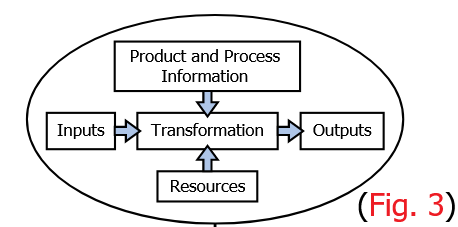
In an article published 2 October 2020 on the website of NIST (the US National Institute of Standards and Technology), KC Morris (leader of the Information Modeling and Testing Group in the Systems Integration Division of NIST) describes the new ASTM standard E3012-20, “Standard Guide for Characterizing Environmental Aspects of Manufacturing Processes.” This standard describes and builds on a Unit Manufacturing Process (UMP), which is shown in the following figure.

Source: https://www.astm.org/Standards/E3012.htm

What does it mean?

The simplest model of any manufacturing process involves identifying the inputs, the process, and the outputs, as shown at the top of this post.

Thus, when I make my breakfast, I use inputs (soy milk, yogurt, CBD oil, hemp protein powder, and frozen fruit), which I blend in a food processor to create the output, my breakfast smoothie.

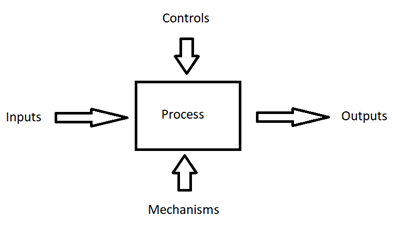
There is a long history of modeling manufacturing process in such a way, with more details. My first faculty office at Purdue University was next door to the office of Alan Pritsker, one of the founders of the field of computer simulation, and from him I learned about the development of IDEF, Integrated DEFinition Methods in the 1970s, which in turn had been developed from SADT  (Structured Analysis and Design Technique). Much of the work happened in the Air Force program ICAM (Integrated Computer Aided Manufacturing, which aimed to create standard data models. The basic element of IDEF0 (IDEF zero) is shown in this diagram:

Source: author

This diagram is the same as the simple Inputs-Process-Outputs diagram with the addition of Controls, which are the inputs that are used to direct the process, and Mechanisms, which are the inputs in the form of the resources and tools used to do the process. In my breakfast example, this expanded diagram allows the explicit identification of the recipe as the Control and the food processor as the Mechanism.

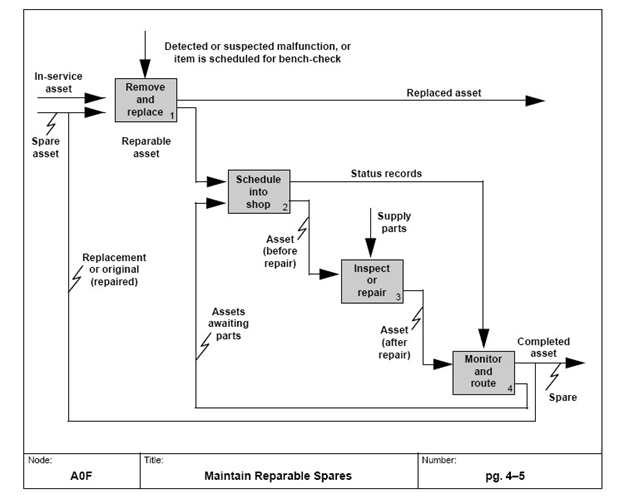
Obviously, in a manufacturing system the output from one process is input to the next process. IDEF0 blocks can be joined, resulting in a diagram such as this one showing the flow of physical objects and information:

Source: https://commons.wikimedia.org/wiki/File:IDEF_Diagram_Example.jpg.
This diagram is in the public domain.

These diagrams and concepts support thinking about processes and systems in manufacturing, resulting in systematic thinking (each process is documented and diagrammed in a similar way) and also systemic thinking (the relationship among processes is documented and can be studied).

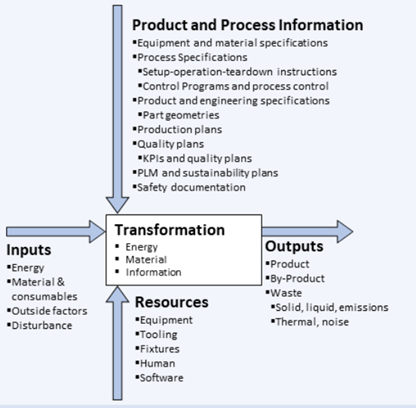
The newly proposed UMP is obviously a new version (or reinvention) of SADT and IDEF – and probably of some other similar diagrams that I am not familiar with. An expanded version of the UMP is shown below:

As compared to IDEF0, Transformation is another word for Process, Product and Process Information plays the role of Controls, and Resources the role of Mechanism. The difference from IDEF0 is that the emphasis in this new standard is on being able to describe and measure the environmental aspects of a manufacturing process. The standards are meant to help manufacturers better understand these environmental impacts and thus  make better decisions about trade-offs among goals such as minimizing the use of resources and maximizing the speed of manufacturing.

What does it mean for you?

Systems thinking is a good thing. The simple step of drawing a line around a set of tasks and calling them a process seems trivial but it focuses one’s thinking on those tasks, it highlights the flow of material and information to support those tasks, and it supports the connection of those tasks to the previous and following tasks. With such thinking, a process then is a system, and it is part of a larger system.

Diagrams are good things. I always told my graduate students that we were well on our way with their work when we had a diagram that captured the basic ideas. As I have shown, the new UMP is not new, but the UMP diagram with arrows and labels is compelling: the concepts work, the words capture the ideas, and the lists associated with the major concepts make sure that the correct details are considered.

Finally, it really doesn’t matter which version of Inputs-Process-Outputs your organization uses. Pick a diagram, pick some words – even develop your own. Agree to use the diagram and the words throughout your organization and then get started on diagramming all the processes and systems. You will learn a lot about how your organization actually works if you make sure the results capture what is really happening and not just what is supposed to happen. You will certainly find that with some processes people don’t even agree on what is happening. A gemba walk (“gemba” is a Japanese word meaning, I am told, “the actual place”) will help; go and look at what is actually happening.

Where can you learn more?

Another example of the application of IDEF to furniture manufacturing is here. Dr Pritsker’s application of the IDEF methodology to modeling is described here.

Background on the issues that led to the development of the new ASTM standard are described in this 2016 paper.

ASTM, founded in 1898, used to stand for the American Society for Testing and Materials. Its name is now ASTM International.

There is so much available on process mapping that I hesitate to cite one or a few recommendations, but the ASQ (American Society for Quality) website is always a great starting place. Here is a good introduction from Netmind.

I’ll have a lot more to say about systems thinking in future posts.

This work is licensed under a Creative Commons Attribution 4.0 International License.

Charge me up

What’s new?

Bloomberg Quint reported two weeks ago that six Tesla batteries are now providing backup power to meet peak demand for electricity in a project in southwest England.   

What does it mean?

“[D]esigned for utilities and large-scale commercial customers,” a Tesla Megapack battery is an integrated package of storage of up to 3 MWh of energy with all the controls, cooling system, and inverters needed to connect the storage to an electrical system. Their modular design means they can be connected to each other to create large storage capacity. “1 Gigawatt hour (GWh) project provides record energy capacity—enough to power every home in San Francisco for 6 hours.”

Electricity must be provided instantaneously as users turn devices on and off, requiring electricity generation that can ramp up and down quickly. Stand by power for meeting peak demand is often the most expensive part of an electrical system because it is used so rarely but has to be present to guarantee meeting demand during the peaks. Typically peaker plants burn natural gas to generate electricity.

The sun doesn’t always shine, the wind doesn’t always blow, and the water doesn’t always flow, so renewable energy sources are at a disadvantage compared to using fuels to generate power, but energy storage technologies (such as batteries, pumped water, stored heat, etc.) are increasingly enabling the world to move electricity generation toward 100% renewable while maintaining reliability. By replacing electricity generated by fuel with electricity generated by renewable energy in base power (the generating plants that run all the time) and by using electricity storage for to generate peak power, a system can take advantage of renewable energy when it is available and still make sure the lights come on when the light is turned on. Charge the battery when the sun shines, the wind blows, and the water flows, then discharge it as needed.

Other changes in technology can support a system designed for 100% renewable including demand side management (utility company strategies that reduce the peak demand of users), integration of electrical grids (strategies to ship power from places with more than is needed to places experiencing shortages), and energy efficiency (strategies to reduce base power demand because the cheapest energy is still the energy saved). Improvements in manufacturing have already contributed to the decline in the costs of solar panels and wind turbines, and such improvements will also contribute to a continued decline in the price of battery storage.

Many large and small changes are contributing to these developments. For example, people are looking at how the batteries in electric vehicles can be used as storage devices not just to power transportation but also to feed back into the system at times of peak demand.

It’s all about the probabilities. Electric utilities measure reliability by SAIDI (system average interruption duration index), the total duration of interruptions as experienced by the average customer. The ideal is zero, of course, but some interruptions are inevitable during events such as hurricanes or earthquakes. Schools that have moved on line have speculated that snow days are in the past, but in my part of rural Colorado, the teacher and students may no longer need to get to the school in the snow, but they still need the electricity to be on so they can be online.

It’s not just the power, however, it’s also the frequency and voltage. I have oversimplified a bit by focusing on the provision just of the peak and base power; the electricity system must generate power  with stability in the parameters that matter in the use of the electricity.

What does it mean for you?

When you flip the switch on a light in your home or turn on a computer or a machine in your manufacturing facility, you want the device to come on and stay on. Because of developments like the Tesla battery, the future is bright – and reliable.

You and I can help move toward that future. Next week I am having my shingle roof replaced with a metal roof.  Then I will look at replacing the propane fueled heat in my house with an electric heat pump. Solutions that may have made sense 20 years ago when I had the house built need reexamination now. And I expect our upcoming purchase of a new refrigerator to reduce our energy consumption since consumer appliances continue to improve on this measure.

Where can you learn more?

Consultants abound to help you reduce your energy use in your business, but the place to start may be your electricity provider. They often have programs and incentives. Your next stop should be your state and local governments which may have substantial programs to reduce energy use.  Also, see this directory. Homeowners may be aware of the Energy Star ratings for home appliances; the program is also supports reduction of energy use in industrial companies.

Learning the language of energy consultants can help you find the right partner.  NIST (the US National Institute of Standards and Technology) has 51 Manufacturing Extension Partnerships (one in every state and Puerto Rico) which can help you find an energy consultant, as well help small and medium sized manufacturers with many other issues.

Energy service companies can design a performance contract to pay for changes through projected energy cost savings. The National Association of Energy Service Companies has a list of companies who have been accredited by this association. Thomas Net lists 855 suppliers of energy consulting services.

This image has an empty alt attribute; its file name is image-1.png

This work is licensed under a Creative Commons Attribution 4.0 International License.

WEBER/WEAVER siblings in the 1800s in Ohio

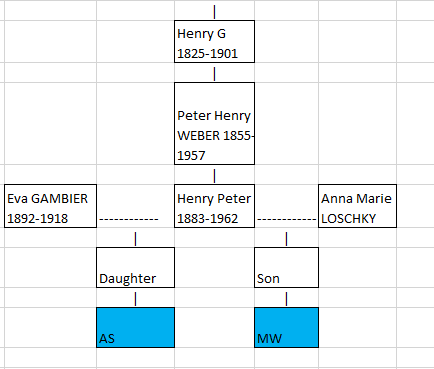
I am tracing the ancestors of MW, who is descended from Henry G WEBER, born 1825 in Germany and died 1901 in Ohio. In this post, I describe my evidence for the hypothesis that Henry WEBER had at least three brothers and one sister who also moved from Germany and who also settled in Ohio. I first describe the evidence from DNA and then describe other evidence that links these five people.

I have access on Ancestry to the DNA matches of MW and his half-cousin AS, whose relationship is shown in the figure below.

The five people I believe to be siblings are:

  • Peter WEAVER, b about 1812 in Germany
  • William WEAVER b 19 Oct 1813
  • Magdalena WEAVER, b about 1822
  • George WEAVER, born Nov 1823
  • Henry WEBER, b 24 Jun 1825 – ancestor of MW and AS

While Henry used the surname WEAVER in the 1840s and 1850s for civil records and WEBER for church records, he and his descendants then stuck with the German WEBER. The other four similarly used WEAVER for civil records and WEBER for church records in their early days in the US, but their descendants used and still use the surname WEAVER. Most search engines do not return records with surname WEAVER when the surname WEBER is searched, so I believe these siblings were hiding in plain sight.

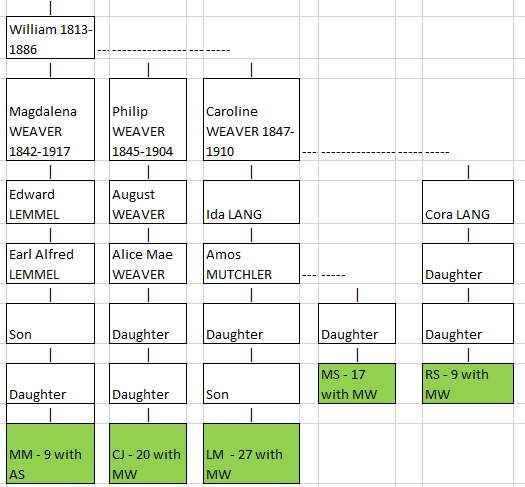
For the first WEAVER, Peter, I have no DNA evidence of a connection to Henry. I present evidence later for why I include him in this list. For the next three, I have DNA evidence of a connection to Henry, using the DNA of MW and AS on ancestry.com

The DNA evidence for the second, William, is shown in this figure, showing a match (in cM, or centiMorgans) of MW or AS with descendants of three of William’s offspring. Surnames of William’s offspring include LEMMEL, MUTCHLER, SNYDER, STRANG, SMITHHISLER, WANDER, and HUNTER, primarily in Holmes County.

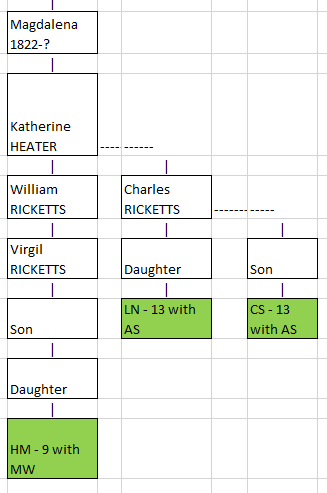
The DNA links with the third WEAVER, Magdalena are shown below. MW or AS has links with three descendants.  Surnames include HEATER, RICKETTS, DEAN, SHEPARD, and BROOKS, primarily in Logan County, Ohio.

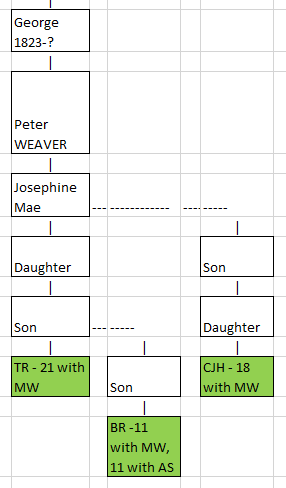
The links with the final WEAVER, George, are shown below. MW and AS have links with three of George’s descendants; MW and AS both link to one of the descendants, BR. Surnames include HENRY, KESTER, PITTS, and SULLIVAN, in Logan and Champaign Counties, Ohio.

All these matches are in the expected range of cM for the relationship, according to the table from the International Society of Genetic Genealogy (ISOGG). For example, AS and LN are fourth cousins, which has a range of 0 to 127 cM, a range that contains their actual match of 13 cM. As shown in this table, again from the ISOGG, there is approximately a 40 to 50% chance that fourth cousins have no shared DNA.

Because Ancestry does not have a chromosome browser it is impossible for me to determine if these matching segments are on the same portions of the same chromosomes. For example, I don’t know if the 11 cM that MW and AS share with BR, the descendant of George WEAVER, are the same 11 cM. Most importantly, some other explanation could exist for all these matches, but the sheer number of matches makes it likely that these five people are related to each other. If not siblings, they could be cousins. 

In addition to DNA evidence, I also have evidence of some interactions among these people. In this list I use WEBER or WEAVER as used in the original document.

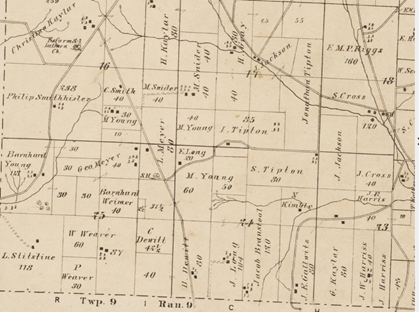
  • In 1846, a Magdalena WEBER was the witness on the baptism of Magdalena, the daughter of Peter WEBER and wife Dorothea. This baptism took place in St John’s Lutheran Church in Holmes County, Ohio. (This church is listed in ancestry.com records as located in Greer, which is just into Knox County from Holmes County, but I believe the church was actually located in Holmes County, at the location of what is now called Kaylor Ridge Cemetery; see map below.)
  • In 1847, Peter WEBER was a witness on the baptism at St John’s of Caroline WEBER, daughter of William WEBER and his wife Salomea SPRANG.
  • In 1849, Wilhelm WEBER was the witness on the baptism at St John’s of Wilhelm WEBER, son of Peter WEBER and his wife Dorothea.
  • In the 1850 census, Peter WEAVER is in Richland Township, and William WEAVER is in Knox Township, Holmes County. These are adjoining townships.
  • In 1851 the second child of Henry WEBER and his wife Magdalena SCHMIDT, Magdalena WEBER, was baptized at St John’s. A witness on that baptism was Salomea WEBER, nee SPRANG, wife of William WEAVER. Magdalena was the only child of Henry baptized in that church.
  • Peter WEAVER and his wife Dorothea SPRANG and William WEAVER and his wife Salomea SPRANG attended St John’s church for decades. All four are buried in the church’s cemetery, now known as Kaylor Ridge Cemetery, in Holmes County.
  • In 1875, Caldwell’s Atlas of Holmes County shows adjacent lands owned by W WEAVER and P WEAVER in Knox County, south of St John’s Church. Other similar maps exist for other years, showing Peter and William living nearby each other. Note the church in the top left corner of this map, now the site of Kaylor Ridge Cemetery.
  • In 1882, the third child of Henry WEBER and Magdalena SCHMIDT, Jacob Frederick WEBER (1853-1920) married Caroline SCHNEIDER, a member of St John’s. Henry WEBER and family had moved from Holmes County by the time of Jacob’s birth, but must have kept in touch for decades.

These facts indicate a close connection, I believe, among Peter WEAVER, William WEAVER, and Henry WEBER. Thus, despite the lack of DNA match to descendants of Peter WEAVER, I include him in the list of relatives, probably siblings.

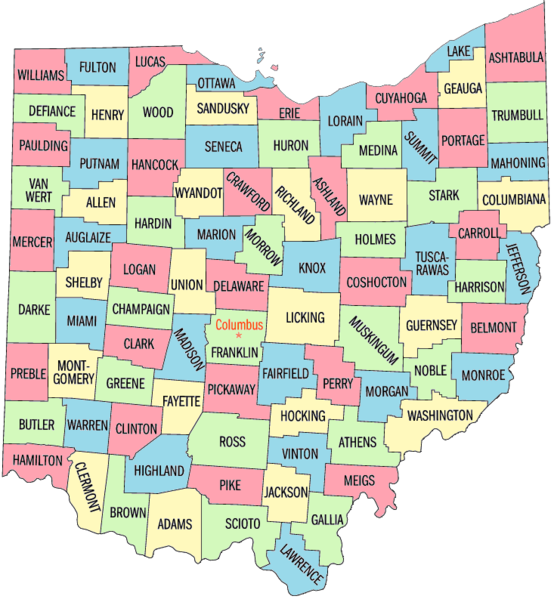
The following county map shows that the five people all settled in areas around Franklin County, Ohio. Henry WEBER settled in western part of Franklin County. Peter and William WEAVER lived in Holmes County, northeast of Franklin County. Magdalena and George WEAVER lived in Logan and Champaign counties, northwest of Franklin County.

Source. Licensed under a GNU Free Documentation License.

I am now working on tracing forward more descendants of the four WEAVER families. I am also tracing backward in time from all five to try to determine the WEBER roots in Germany. I welcome feedback from people related to any of these families. In this blog, I have obscured the names of recent descendants, but I will share that information with people who can help me with this research.

This image has an empty alt attribute; its file name is image-1.png

This work is licensed under a Creative Commons Attribution 4.0 International License.
I shall take the heart

What’s new?

In a new type of 3D printing researchers at NIST (the US National Institute of Standards and Technology) have developed a method to use beams of electrons or X-rays to grow gels in a liquid.

What does it mean?

3D printing is better described as additive manufacturing, as contrasted with subtractive manufacturing. In subtractive manufacturing a large piece of material is whittled away and reduced to the desired shape, inevitably resulting in wasted material. In additive manufacturing the desired object is built up by adding material exactly where it is needed; some waste may still result due to, for example, the need for scaffolding to support the object as it is created, but usually additive manufacturing enables the creation of objects we can’t make with subtractive manufacturing.

Two major processes for additive manufacturing are extrusion or jetting, where a substance, usually heated to make it flow, is deposited into the desired share, and solidification, where radiation is used to selectively solidify a liquid or powder material.

This new solidification method uses a liquid of polymers and results in a gel, which is a soft solid. Such methods for creating gels have been used before, but this new method uses X-rays, rather than ultraviolet or visible laser light and does not require the addition of special molecules in the liquid to initiate the formation of gels.

Types of engineering can be roughly distinguished by the branch of physics they rely on: for example, mechanical engineering on mechanics, civil engineering on statics, and electrical engineering on electricity. Chemical engineering is unique in relying on chemistry. Increasingly, however, all engineering areas, not just biological engineering, are realizing that biology is an important science, whether as a source of ideas through biomimicry or as an important area of application.

This new method of solidification relies on physics, especially the physics of electromagnetic radiation. Such radiation varies from the longest wavelength radiation used for radio transmission to the shortest wavelength radiation called gamma rays. Visible light is about in the middle of that spectrum, with ultraviolet and X-ray moving toward shorter wavelength. The important fact from physics for this new NIST method is that the shorter wavelength of X-ray radiation means that it can be focused more accurately and thus can create finer structures than those created using visible or ultraviolet radiation.

However, the use of such short wavelength radiation requires a vacuum, and the liquid of polymers would evaporate. The researchers applied their knowledge of chemistry to add an ultrathin barrier of silicon nitride, a compound of silicon and nitrogen with a very high melting point, making it useful in this application. The NIST article states: “The method enabled the team to use the 3D-printing approach to create gels with structures as small as 100 nanometers (nm) — about 1,000 times thinner than a human hair. By refining their method, the researchers expect to imprint structures on the gels as small as 50 nm, the size of a small virus.”

Finally, biology is the expected application area for this new technique. The NIST article concludes: “Some future structures made with this approach could include flexible injectable electrodes to monitor brain activity, biosensors for virus detection, soft micro-robots, and structures that can emulate and interact with living cells and provide a medium for their growth.”

Our human fascination for robots began with envisioning creations using mechanical and electronic components, based on physics. Think of real applications in prosthetic limbs and pacemakers and think of science fiction creations such as cyborgs in movies. This brief look at cyborgs in film argues that the Tin Man in the movie The Wizard of Oz was the first film cyborg.

But that article points out that the Tin Man wanted that softer piece of human anatomy, a heart. That desire points to the new frontier in human-machine creations. Beyond the notions of wetware (the human body is like computer software) or liveware (you need a human to run any software) lie the frontiers of transhumanism (we should consciously use technology to evolve new humans) and extreme forms of biohacking (you can change your body now to extend its capabilities).

What does it mean for you?

Physics plus chemistry plus biology equals exciting new developments that will eventually create new forms of robots and cyborgs. The new process NIST creates a gel, a soft solid, and such gels have many applications. New structures (for example sol-gel derived products, made from a solution and a gel) are being developed that combine hardness and porosity, stiffness and flexibility, and inertness and reactivity. Sensor and battery technology will benefit but so will the detection and cure of human ailments and frailties.

Another lesson for us all is that progress often occurs at the interfaces between fields. If I were starting over my career as an engineer, I would learn more chemistry and biology. In your career and in the people you hire, look for those who can span fields.

Where can you learn more?

I often recommend the magazine New Scientist if you want to follow developments in science, but NIST newsletters are also exciting ways to learn about these new frontiers. Unfortunately NIST doesn’t seem to have one place listing all its blogs and newsletters, but almost every topic area seems to have some subscription service, from forensic science to weights and measures.

The idea that people with multiple areas of expertise are helpful is obvious, but the idea takes many forms, from cross training to boundary spanners, and is certainly worth repeating.

This image has an empty alt attribute; its file name is image-1.png

This work is licensed under a Creative Commons Attribution 4.0 International License.